Reviewing Rules of the Road and Traffic Signs
複習交通規則和標誌
The student and instructor are going over common traffic signs, road markings, and basic traffic laws to prepare for the written theory test or to reinforce observational skills.
學員和教練一起復習常見的交通標誌、道路標線和基本的交通法規,為理論考試做準備或鞏固觀察能力。
對話9
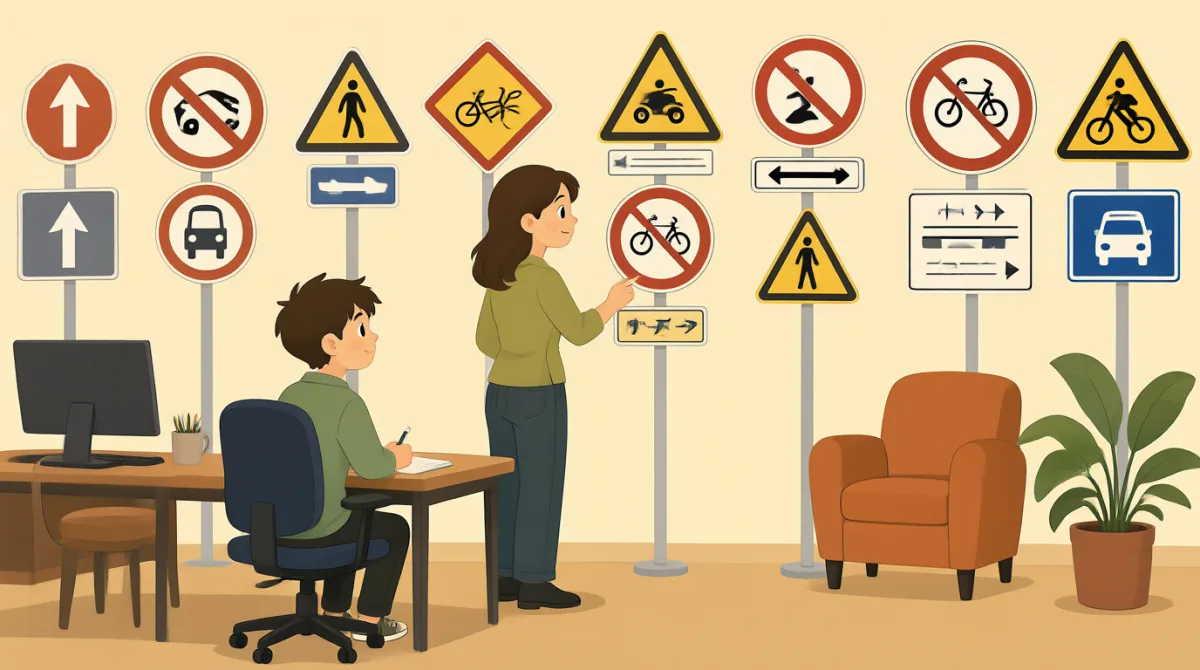

Alright Emma, let's go over some of the trickier traffic signs and road markings today. These often trip people up on the written test.
好的,艾瑪,今天我們來複習一些比較棘手的交通標誌和道路標線。這些經常在筆試中難倒大家。

Sounds good, David! I'm ready. I've been reviewing the manual, but some of the subtle differences between signs still confuse me.
聽起來不錯,大衛!我準備好了。我一直在看手冊,但有些標誌之間的細微差別還是讓我困惑。
Perfect. Let's start with 'No Parking' vs. 'No Stopping' signs. What's the key difference you need to remember for the test?
很好。我們從“禁止停車”和“禁止停靠”標誌開始。對於考試,你需要記住的關鍵區別是什麼?
Okay, 'No Parking' means you can stop briefly to pick up or drop off passengers, but you can't leave your vehicle. 'No Stopping' means you can't stop for any reason, not even for a moment.
嗯,“禁止停車”意味著你可以短暫停車接送乘客,但不能離開車輛。“禁止停靠”意味著你不能以任何理由停車,即使是一瞬間也不行。
Excellent! You got it. That's a common one people mix up. Now, tell me about the meaning of a solid white line versus a dashed white line on a multi-lane highway.
太棒了!你答對了。這是人們經常混淆的一個。現在,告訴我多車道高速公路上實線白線和虛線白線的區別是什麼?
A solid white line means you shouldn't change lanes, while a dashed white line means you can change lanes if it's safe to do so.
實線白線表示你不應該變道,而虛線白線表示如果安全的話,你可以變道。
Spot on. And where do you typically see solid white lines often used, besides marking the edge of the road?
完全正確。除了標記路邊,你通常在哪裡看到實線白線被頻繁使用?
At intersections, solid white lines are often used as stop lines or crosswalks. And also on bridges, I believe, where lane changes are discouraged.
在交叉路口,實線白線通常用作停車線或人行橫道。而且我相信在橋樑上也是,那裡不鼓勵變道。
That's right, especially near intersections or in tunnels/bridges where visibility is limited or safety is paramount. You're doing great, Emma. Keep up the good work and you'll ace that theory test!
沒錯,尤其是在能見度受限或安全至關重要的交叉路口附近或隧道/橋樑中。你做得很好,艾瑪。繼續努力,你一定會透過理論考試的!
詞彙12
- trickier棘手的
Means more difficult or complicated than usual. Use it when talking about challenging parts of a test or task, like 'These questions are trickier than I thought.'
表示比平常更困難或更復雜。談論考試或任務中具有挑戰性的部分時可以使用,例如:'These questions are trickier than I thought.'(這些題比我想象的更棘手。)
- traffic signs交通標誌
Signs on roads that give rules, warnings, or directions to drivers. Important for driving tests; for example, 'Always obey traffic signs to stay safe.'
指道路上為駕駛員提供規則、警告或方向的標誌。這是駕駛考試中的重要內容;例如:'Always obey traffic signs to stay safe.'(為了保證安全,始終遵守交通標誌。)
- road markings道路標線
Lines or symbols painted on the road to guide drivers, like lane lines. Useful in driving contexts: 'Watch the road markings when changing lanes.'
指畫在道路上的線條或符號,用來引導駕駛員,例如車道線。在駕駛場景中很實用:'Watch the road markings when changing lanes.'(變道時要注意道路標線。)
- subtle細微的
Small and not easy to notice. Use when describing small differences: 'The subtle changes in the signs can be confusing at first.'
表示很小且不容易察覺。描述細小差異時可以使用:'The subtle changes in the signs can be confusing at first.'(標誌上的細微變化一開始可能會讓人困惑。)
- No Parking禁止停車
A traffic sign meaning you cannot leave your vehicle parked there, but you can stop briefly. Common in urban areas; remember it for driving rules.
表示不能把車輛停在那裡,但可以短暫停留。城市中很常見,記住它對掌握交通規則很有幫助。
- No Stopping禁止停靠
A stricter traffic sign meaning you cannot stop your vehicle at all, even for a short time. Used in dangerous areas; key for safety tests.
比“禁止停車”更嚴格,表示車輛完全不能停下,即使只是短暫停留也不行。危險路段常使用這個標誌,也是安全考試中的重點。
- solid white line實線白線
A continuous white line on the road that means you should not cross it or change lanes. Often seen at edges or no-passing zones.
指道路上的連續白線,表示不應越過這條線或變道。通常可以在道路邊緣或禁止超車路段看到。
- dashed white line虛線白線
A broken white line on the road allowing safe lane changes. Use in sentences like 'You can pass over a dashed white line if clear.'
指道路上的斷續白線,在確保安全的情況下允許變道。可以這樣用:'You can pass over a dashed white line if clear.'(如果路況暢通,你可以越過虛線白線。)
- intersections交叉路口
Places where two or more roads meet and cross. Crucial for driving: 'Be careful at intersections and yield to others.'
指兩條或多條道路相交的地方。駕駛時非常重要:'Be careful at intersections and yield to others.'(在交叉路口要小心,並禮讓其他車輛和行人。)
- visibility能見度
How well you can see ahead, affected by weather or light. In driving: 'Poor visibility means slow down and use lights.'
指你能看清前方的程度,會受到天氣或光線的影響。在駕駛場景中可以這樣說:'Poor visibility means slow down and use lights.'(能見度低意味著要減速並開燈。)
- paramount至關重要的
Means of the highest importance. Use formally: 'Safety is paramount when driving on bridges.'
表示最重要的,通常用於比較正式的表達。可以這樣用:'Safety is paramount when driving on bridges.'(在橋上駕駛時,安全至關重要。)
- ace輕鬆透過
Slang for doing something extremely well, like passing a test easily. Informal: 'You'll ace the exam if you study hard.'
是口語表達,表示某件事做得非常好,比如輕鬆透過考試。屬於非正式用法:'You'll ace the exam if you study hard.'(如果你努力學習,就能輕鬆透過考試。)
關鍵句7
- 1
Alright Emma, let's go over some of the trickier traffic signs and road markings today.
好的,艾瑪,今天我們來複習一些比較棘手的交通標誌和道路標線。
This is a way to start a lesson or review session politely. 'Go over' means to review or discuss. Useful for teachers or students preparing for exams; shows initiative in learning.
這是一種禮貌地開始課程或複習的說法。'Go over' 表示複習或討論。老師或學生準備考試時都可以使用,體現出積極主動的學習態度。
- 2
Sounds good, David! I'm ready.
聽起來不錯,大衛!我準備好了。
A positive response showing agreement and preparedness. 'Sounds good' is casual for 'That seems fine.' Great for conversations when accepting plans; builds rapport in class.
這是表示贊同和準備就緒的積極回應。'Sounds good' 是 'That seems fine.' 的口語說法。在接受計劃或安排時很適合使用,也有助於營造融洽的課堂氛圍。
- 3
What's the key difference you need to remember for the test?
對於考試,你需要記住的關鍵區別是什麼?
Asks for the main distinction in rules. 'Key difference' highlights important contrasts. Useful in study sessions to focus on test essentials; practices question forms with 'what's' for contractions.
這是在詢問規則之間的主要區別。'Key difference' 強調重要的對比。在學習或複習時,可以用它來聚焦考試重點;同時也能練習 what's 這種縮略問句形式。
- 4
'No Parking' means you can stop briefly to pick up or drop off passengers, but you can't leave your vehicle.
“禁止停車”意味著你可以短暫停車接送乘客,但不能離開車輛。
Explains a rule using 'means' for definition and 'but' for contrast. Practical for describing traffic laws; helps learners understand exceptions in driving regulations.
這句話用 'means' 來解釋定義,用 'but' 表示對比。它適合描述交通法規,也能幫助學習者理解駕駛規定中的例外情況。
- 5
A solid white line means you shouldn't change lanes, while a dashed white line means you can change lanes if it's safe to do so.
實線白線表示你不應該變道,而虛線白線表示如果安全的話,你可以變道。
Compares two things using 'while' for contrast and conditional 'if it's safe.' Useful for explaining road rules; teaches relative clauses and safety conditions in driving.
這句話用 'while' 表示對比,並用 'if it's safe' 表示條件。它適合解釋道路規則,也能幫助學習者練習從句和駕駛中的安全條件表達。
- 6
Spot on.
完全正確。
Idiomatic expression meaning exactly correct. Short and informal praise. Use in feedback situations like tests; common in British English but understood widely for quick approval.
這是一個習慣用語,表示完全正確。它是簡短、非正式的表揚,適合在考試或練習中給予反饋。這個表達在英式英語中很常見,但在其他英語語境中也廣為人知,常用於快速表示肯定。
- 7
You're doing great, Emma. Keep up the good work and you'll ace that theory test!
你做得很好,艾瑪。繼續努力,你一定會透過理論考試的!
Encourages with compliments and future prediction using 'will.' 'Keep up the good work' means continue performing well. Ideal for motivating learners; includes contraction 'you'll' for natural speech.
這句話透過表揚來鼓勵學習者,並用 'will' 表示對未來的預測。'Keep up the good work' 意思是繼續保持良好的表現。它很適合用來激勵學習者,其中的 you'll 是日常口語中常用的縮略形式。