Asking a Roommate
룸메이트에게 물어보기
Emma asks her roommate Jack if he has seen the keys. Jack remembers seeing them near the front door.
에마는 룸메이트 잭에게 열쇠를 봤는지 물어봐요. 잭은 현관문 근처에서 열쇠를 본 기억이 나요.
대화7
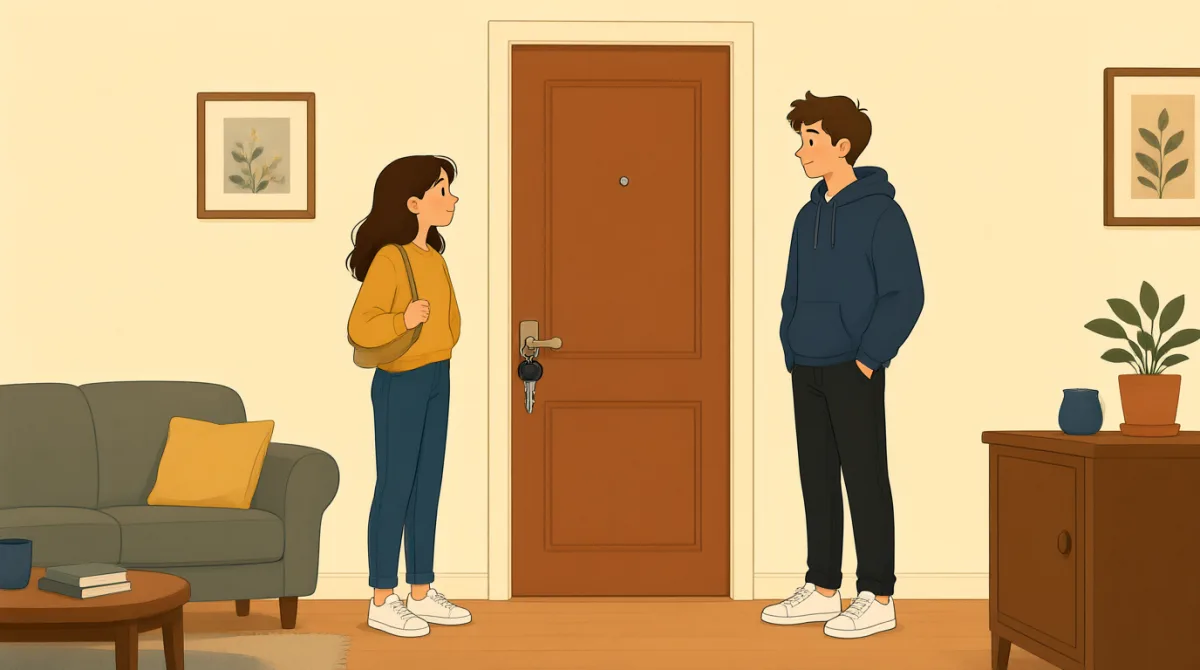

Jack, have you seen my keys?
잭, 내 열쇠 봤어?

Your keys? What do they look like?
네 열쇠? 어떻게 생겼는데?
They are small, with a blue key ring.
작고 파란 열쇠고리가 달려 있어.
I saw them near the front door earlier.
아까 현관문 근처에서 봤어.
Were they on the table or on the floor?
탁자 위에 있었어, 아니면 바닥에 있었어?
I think they were next to your bag.
네 가방 옆에 있었던 것 같아.
Okay, I'll look by the front door.
알았어, 현관문 근처를 찾아볼게.
어휘7
- have you seen my keys?내 열쇠 봤어?
Use this to ask if someone has seen your keys. You can replace “my keys” with another missing item.
누군가에게 열쇠를 봤는지 물어볼 때 쓰는 표현이에요. “my keys” 대신 잃어버린 다른 물건을 넣어도 돼요.
- What do they look like?어떻게 생겼어?
Use this to ask someone to describe something. “They” refers to the keys.
상대방에게 어떤 물건의 생김새를 설명해 달라고 할 때 써요. 여기서 “They”는 열쇠를 가리켜요.
- key ring열쇠고리
A key ring holds keys together. You can describe its color to help someone find your keys.
열쇠고리는 여러 열쇠를 함께 묶어 두는 물건이에요. 열쇠를 찾을 수 있도록 열쇠고리의 색깔을 설명할 수 있어요.
- front door현관문
The front door is the main entrance to a home or building. Use this phrase to say where something is.
“front door”는 집이나 건물의 주 출입문을 뜻해요. 물건이 어디에 있는지 말할 때 이 표현을 쓸 수 있어요.
- on the table탁자 위에
Use this phrase to say that something is resting on a table. “On” tells us where it is.
물건이 탁자 위에 놓여 있다고 말할 때 쓰는 표현이에요. “On”은 물건이 어디에 있는지 알려 줘요.
- next to your bag네 가방 옆에
Use this phrase to say that something is beside a bag. You can replace “your bag” with another object.
물건이 가방 옆에 있다고 말할 때 쓰는 표현이에요. “your bag” 대신 다른 물건을 넣어도 돼요.
- look by the front door현관문 근처를 찾아보다
Use this phrase to say that you will search near the front door. “By” means near.
현관문 근처를 찾아보겠다고 말할 때 쓰는 표현이에요. “By”는 ‘가까이에’라는 뜻이에요.
핵심 문장7
- 1
Jack, have you seen my keys?
잭, 내 열쇠 봤어?
This is a simple way to ask if someone has seen something you cannot find. Replace “my keys” with another missing item.
찾을 수 없는 물건을 누군가가 봤는지 물어보는 간단한 표현이에요. “my keys” 대신 잃어버린 다른 물건을 넣어 보세요.
- 2
What do they look like?
어떻게 생겼어?
Use this question to ask for a description. You can change “they” to “it” when asking about one item.
상대방에게 생김새를 물어볼 때 쓰는 질문이에요. 물건 하나에 대해 물어볼 때는 “they”를 “it”으로 바꿀 수 있어요.
- 3
They are small, with a blue key ring.
작고 파란 열쇠고리가 달려 있어.
This sentence describes the keys and their key ring. Use “They are…” to give details about more than one thing.
열쇠와 열쇠고리의 생김새를 설명하는 문장이에요. 두 개 이상을 설명할 때는 “They are…”로 시작해 자세한 정보를 덧붙일 수 있어요.
- 4
I saw them near the front door earlier.
아까 현관문 근처에서 봤어.
Use this to say where and when you last saw something. Replace “them” with the thing you saw.
무언가를 마지막으로 본 장소와 시간을 말할 때 써요. “them”을 본 물건으로 바꿔서 말해 보세요.
- 5
Were they on the table or on the floor?
탁자 위에 있었어, 아니면 바닥에 있었어?
This question asks someone to choose between two possible places. You can use the same pattern to ask where something was.
가능한 장소 두 곳 중 어디였는지 상대방에게 묻는 질문이에요. 같은 문장 패턴으로 물건이 어디에 있었는지 물어볼 수 있어요.
- 6
I think they were next to your bag.
네 가방 옆에 있었던 것 같아.
Use “I think…” when you are not completely sure. “Next to” tells where something was.
확신이 없을 때는 “I think…”라고 말해요. “Next to”는 물건이 어디에 있었는지 알려 줘요.
- 7
Okay, I'll look by the front door.
알았어, 현관문 근처를 찾아볼게.
Use this to say you will search near a place. “I'll” is short for “I will.”
어떤 장소 근처를 찾아보겠다고 말할 때 쓰는 표현이에요. “I'll”은 “I will”의 줄임말이에요.