Leaving the House
Saindo de casa
Emma and Mia check the time and make sure they have everything. Then they leave the house together.
Emma e Mia conferem as horas e se certificam de que estão com tudo. Depois, saem de casa juntas.
Diálogo6
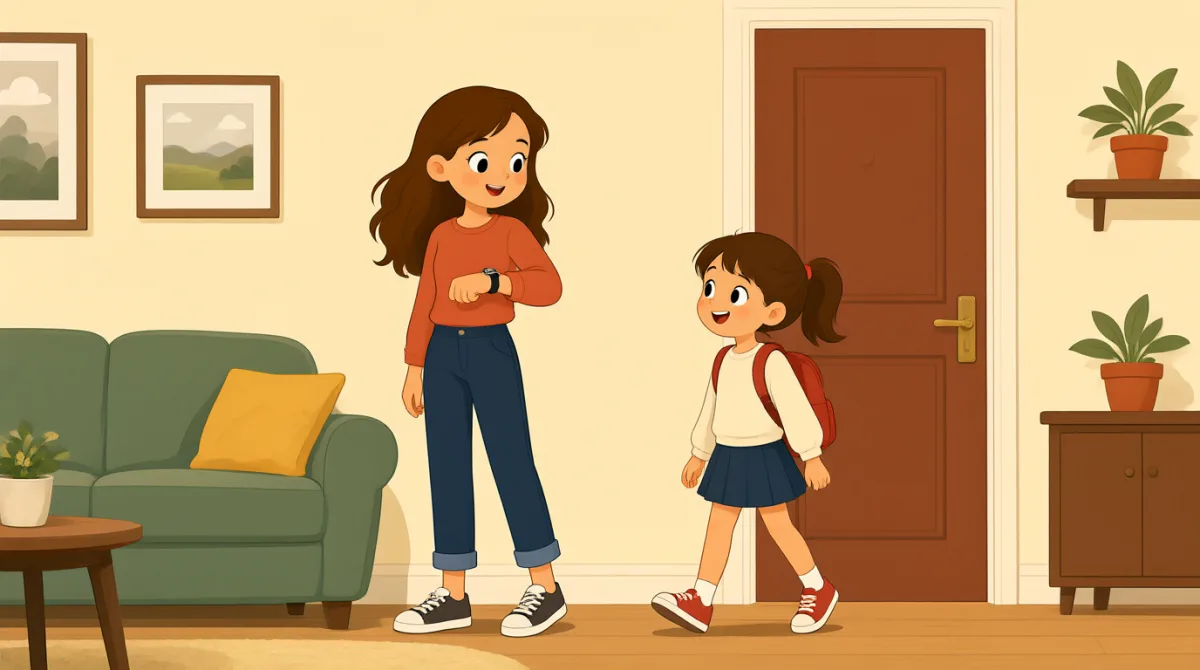

What time is it? Are we ready to go?
Que horas são? Já estamos prontas para sair?

It’s six o’clock. Yes, I have my keys.
São seis horas. Sim, estou com minhas chaves.
I have my phone and my bag.
Estou com meu celular e minha bolsa.
Good. Do you have your jacket?
Ótimo. Você está com sua jaqueta?
Yes, it’s by the door. Let’s go!
Sim, está perto da porta. Vamos!
All right. I’m ready. Let’s leave.
Tudo bem. Estou pronta. Vamos sair.
Vocabulário6
- What time is it?Que horas são?
Use this question to ask for the current time.
Use esta pergunta para saber as horas.
- ready to gopronto para sair
This means prepared to leave. You can ask, “Are you ready to go?”
Isso significa estar preparado para sair. Você pode perguntar: “Are you ready to go?” (Você está pronto para sair?).
- keyschaves
Keys open locks, such as the lock on your front door. You can say, “I have my keys” before leaving.
As chaves abrem fechaduras, como a da porta de entrada. Você pode dizer “I have my keys” antes de sair.
- by the doorperto da porta
This means next to the door. You can use it to say where something is.
Isso significa ao lado da porta. Você pode usar essa expressão para dizer onde algo está.
- Let’s go!Vamos!
Use this phrase to suggest that it is time to leave or start going somewhere.
Use essa expressão para sugerir que está na hora de sair ou de ir a algum lugar.
- leavesair
Here, “leave” means to go out of the house. You can say, “I’m ready to leave.”
Aqui, “leave” significa sair de casa. Você pode dizer: “I’m ready to leave.” (Estou pronta para sair.).
Frases-chave8
- 1
What time is it?
Que horas são?
This is a simple way to ask for the time. You can use it at home, at school, or before meeting someone.
Esta é uma maneira simples de perguntar as horas. Você pode usá-la em casa, na escola ou antes de encontrar alguém.
- 2
Are we ready to go?
Já estamos prontas para sair?
Use this question to check if everyone is prepared to leave. You can change “we” to “you” when asking one person.
Use esta pergunta para saber se todos estão prontos para sair. Você pode trocar “we” por “you” ao perguntar a uma só pessoa.
- 3
It’s six o’clock.
São seis horas.
This is a simple way to tell someone the time. Replace “six” with another number to give a different time.
Esta é uma maneira simples de dizer as horas a alguém. Troque “six” por outro número para indicar um horário diferente.
- 4
I have my keys.
Estou com minhas chaves.
Use this sentence to say that you have your keys with you. You can replace “keys” with another thing you need.
Use esta frase para dizer que está com suas chaves. Você pode trocar “keys” por outra coisa de que precisa.
- 5
Do you have your jacket?
Você está com sua jaqueta?
Use this question to check if someone has an item they need. Replace “jacket” with another item, such as “bag” or “phone.”
Use esta pergunta para saber se alguém está com algo de que precisa. Troque “jacket” por outro item, como “bag” ou “phone”.
- 6
Yes, it’s by the door.
Sim, está perto da porta.
This sentence confirms that something is there and tells where it is. You can use “by the door” to describe the location of another item.
Esta frase confirma que algo está ali e diz onde está. Você pode usar “by the door” para indicar onde outro item está.
- 7
Let’s go!
Vamos!
Use this short phrase to suggest that it is time to leave. You can also say it when you are ready to start an activity.
Use esta expressão curta para sugerir que está na hora de sair. Você também pode dizê-la quando estiver pronto para começar uma atividade.
- 8
I’m ready.
Estou pronta.
Use this sentence to say that you are prepared. You can add “to go,” as in “I’m ready to go.”
Use esta frase para dizer que está preparada. Você pode acrescentar “to go”, como em “I’m ready to go.”