Asking to Sit Down
Pytanie, czy można usiąść
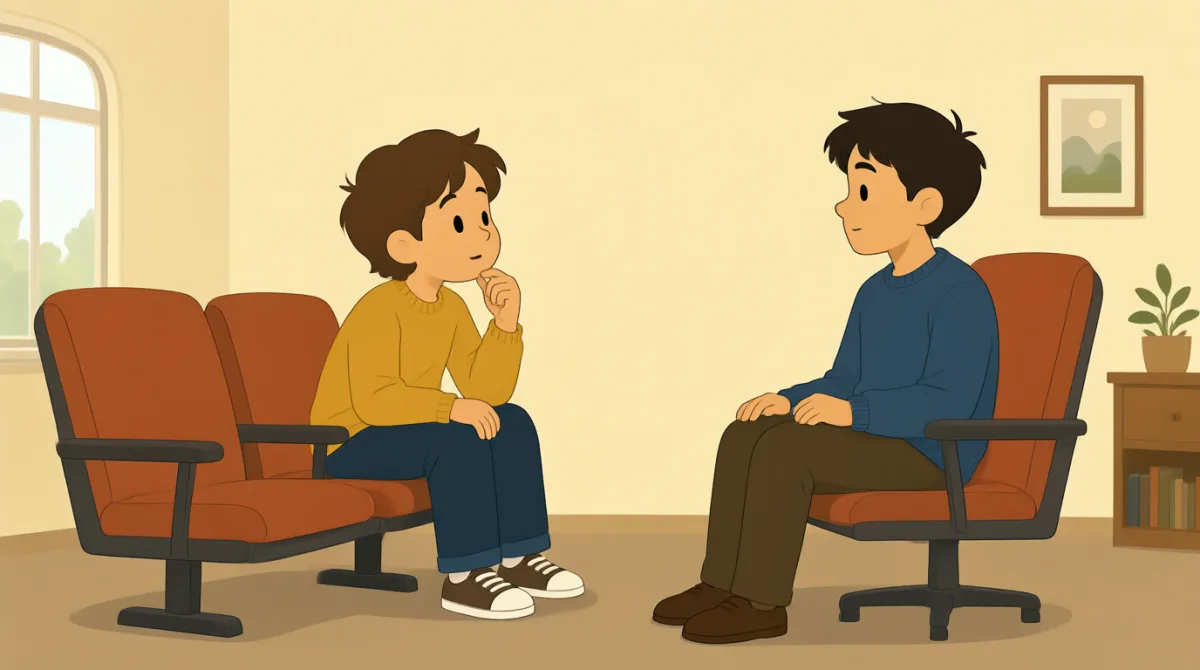
Leo sees an empty seat beside David and politely asks if he can sit there. David says yes.
Leo zauważa wolne miejsce obok Davida i grzecznie pyta, czy może tam usiąść. David się zgadza.
Dialog6

Excuse me, can I sit here?
Przepraszam, czy mogę tu usiąść?

Yes, of course. The seat is free.
Tak, oczywiście. Miejsce jest wolne.
Thank you. Is this your bag?
Dziękuję. Czy ta torba jest twoja?
No, it’s yours if you need it.
Nie, możesz ją wziąć, jeśli jej potrzebujesz.
Thanks. I’ll put it here.
Dzięki. Położę ją tutaj.
Sure. The bus is a little full today.
Jasne. W autobusie jest dziś trochę tłoczno.
Słownictwo7
- Excuse mePrzepraszam
A polite way to get someone’s attention before asking a question.
Grzeczny sposób, by zwrócić czyjąś uwagę, zanim zadasz pytanie.
- Can I sit here?Czy mogę tu usiąść?
A polite way to ask if a seat is free for you to use.
Grzeczny sposób, by zapytać, czy możesz skorzystać z wolnego miejsca.
- of courseoczywiście
A friendly way to say yes.
Przyjazny sposób, by powiedzieć „tak”.
- The seat is free.Miejsce jest wolne.
This means nobody is using the seat.
To znaczy, że nikt nie zajmuje tego miejsca.
- if you need itjeśli jej potrzebujesz
This means you can use something when it is useful to you.
To znaczy, że możesz skorzystać z czegoś, jeśli ci się przyda.
- put it herepołożyć to tutaj
This means place something in this spot.
To znaczy umieścić coś w tym miejscu.
- a little fulltrochę tłoczno
This means there are many people on the bus, but it is not completely full.
To znaczy, że w autobusie jest dużo osób, ale nie jest całkiem pełny.
Kluczowe zdania7
- 1
Excuse me, can I sit here?
Przepraszam, czy mogę tu usiąść?
Use this polite question to ask if you can use a seat. You can change “here” to name another place.
Użyj tego grzecznego pytania, żeby zapytać, czy możesz zająć miejsce. Możesz zamienić “here” na nazwę innego miejsca.
- 2
Yes, of course.
Tak, oczywiście.
Use this friendly phrase to agree to a request. You can also say it when someone asks for help.
Użyj tego przyjaznego zwrotu, by zgodzić się na prośbę. Możesz też tak powiedzieć, gdy ktoś prosi cię o pomoc.
- 3
The seat is free.
Miejsce jest wolne.
Use this sentence to tell someone that nobody is using a seat. You can replace “seat” with another available place or item.
Użyj tego zdania, by powiedzieć komuś, że nikt nie zajmuje danego miejsca. Możesz zastąpić “seat” innym dostępnym miejscem lub przedmiotem.
- 4
Is this your bag?
Czy ta torba jest twoja?
Use this question to check who an item belongs to. Change “bag” to another object, such as “phone” or “coat.”
Użyj tego pytania, by sprawdzić, do kogo należy dany przedmiot. Zastąp “bag” innym przedmiotem, na przykład “phone” lub “coat.”
- 5
No, it’s yours if you need it.
Nie, możesz ją wziąć, jeśli jej potrzebujesz.
Use this sentence to offer something to another person. Replace “it” with the thing you are offering.
Użyj tego zdania, by zaoferować coś drugiej osobie. Zastąp “it” nazwą oferowanej rzeczy.
- 6
I’ll put it here.
Położę ją tutaj.
Use this sentence to say where you will place something. Replace “here” with a place, such as “on the seat.”
Użyj tego zdania, by powiedzieć, gdzie coś położysz. Zastąp “here” nazwą miejsca, na przykład “on the seat.”
- 7
The bus is a little full today.
W autobusie jest dziś trochę tłoczno.
Use this sentence to describe a bus with many people on it. You can change “bus” to another place, such as “the room.”
Użyj tego zdania, by opisać autobus, w którym jest dużo osób. Możesz zamienić “bus” na inne miejsce, na przykład “the room.”