Choosing the Soup
Die Suppe auswählen
Jack tells Emma about the soup choices. Emma picks a soup and asks for a topping.
Jack erzählt Emma, welche Suppen es gibt. Emma wählt eine Suppe und fragt nach einer Beilage.
Dialog8
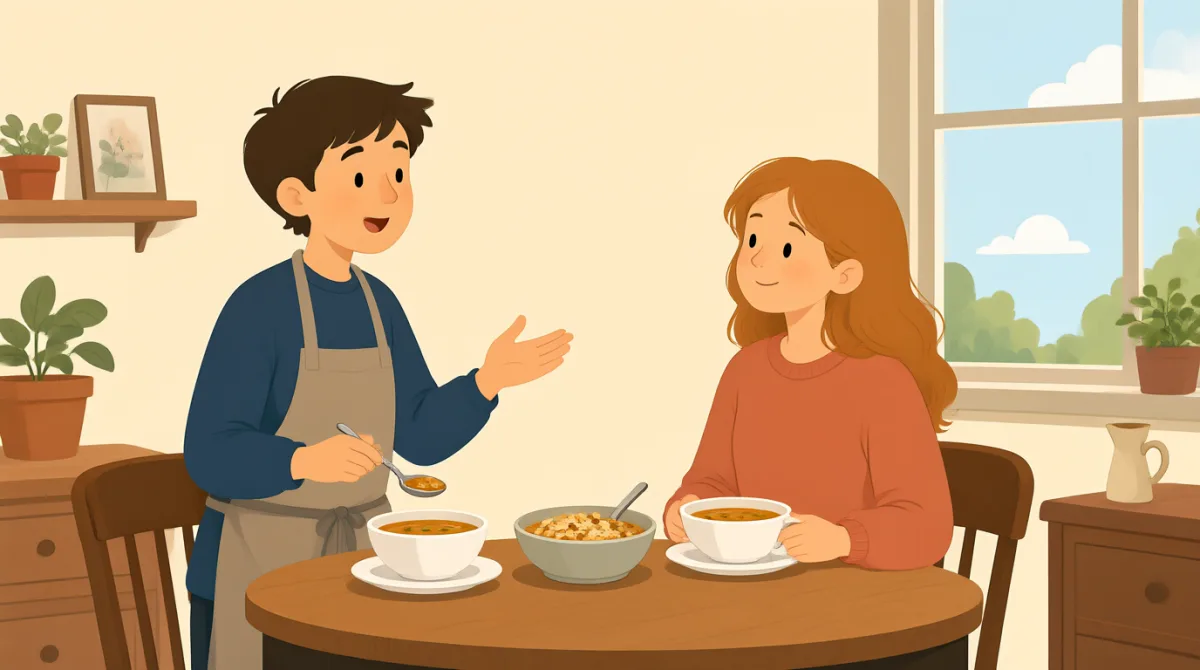

What soup would you like with your noodles?
Welche Suppe möchten Sie zu Ihren Nudeln?

What soups do you have?
Welche Suppen haben Sie?
We have chicken soup and beef soup.
Wir haben Hühnersuppe und Rindfleischsuppe.
I’ll have chicken soup, please.
Ich nehme bitte Hühnersuppe.
Would you like an egg on top?
Möchten Sie ein Ei obendrauf?
Yes, please. How much is the egg?
Ja, bitte. Wie viel kostet das Ei?
It’s one dollar.
Es kostet einen Dollar.
That’s fine. Please add one egg.
Das ist in Ordnung. Bitte geben Sie ein Ei dazu.
Wortschatz8
- What soup would you likeWelche Suppe möchten Sie?
This is a polite way to ask someone to choose a soup. You can use “What [food] would you like?” to ask what they want.
Das ist eine höfliche Art, jemanden nach seiner Suppenwahl zu fragen. Mit „What [food] would you like?“ kannst du fragen, was jemand möchte.
- What soups do you have?Welche Suppen haben Sie?
Use this question to ask which kinds of soup are available. You can replace “soups” with another food or drink.
Mit dieser Frage erkundigst du dich, welche Suppensorten es gibt. Du kannst „soups“ durch ein anderes Essen oder Getränk ersetzen.
- chicken soupHühnersuppe
This is soup made with chicken. It is one of the choices in the conversation.
Das ist eine Suppe mit Hühnerfleisch. Sie ist eine der Auswahlmöglichkeiten im Gespräch.
- beef soupRindfleischsuppe
This is soup made with beef. It is another choice on the menu.
Das ist eine Suppe mit Rindfleisch. Sie ist eine weitere Wahl auf der Speisekarte.
- I’ll have chicken soup, please.Ich nehme bitte Hühnersuppe.
This is a polite way to order something. Replace “chicken soup” with the food you want.
So kannst du höflich etwas bestellen. Ersetze „chicken soup“ durch das Essen, das du möchtest.
- on topobendrauf
This means placed on the top of a dish. You can ask if someone wants an ingredient “on top.”
Das bedeutet, dass etwas oben auf ein Gericht kommt. Du kannst fragen, ob jemand eine Zutat „on top“ haben möchte.
- How much is the egg?Wie viel kostet das Ei?
Use this question to ask the price of something. Replace “the egg” with the item you want to ask about.
Mit dieser Frage erkundigst du dich nach dem Preis. Ersetze „the egg“ durch den Artikel, nach dessen Preis du fragen möchtest.
- Please add one egg.Bitte geben Sie ein Ei dazu.
Use this polite sentence to ask for an extra item in your food. Replace “one egg” with what you want added.
Mit diesem höflichen Satz kannst du um eine zusätzliche Zutat bitten. Ersetze „one egg“ durch das, was du hinzufügen lassen möchtest.
Wichtige Sätze8
- 1
What soup would you like with your noodles?
Welche Suppe möchten Sie zu Ihren Nudeln?
This is a polite question for asking someone to choose a soup. You can use “What [food] would you like with your [meal]?” in a restaurant.
Das ist eine höfliche Frage, mit der du jemanden bitten kannst, eine Suppe auszuwählen. Im Restaurant kannst du die Formulierung „What [food] would you like with your [meal]?“ verwenden.
- 2
What soups do you have?
Welche Suppen haben Sie?
Use this to ask what kinds of soup are available. You can replace “soups” with other menu items, such as drinks or noodles.
Mit dieser Frage erkundigst du dich, welche Suppensorten es gibt. Du kannst „soups“ durch andere Gerichte auf der Speisekarte ersetzen, zum Beispiel Getränke oder Nudeln.
- 3
We have chicken soup and beef soup.
Wir haben Hühnersuppe und Rindfleischsuppe.
This sentence gives someone a choice between two items. You can use “We have [choice one] and [choice two]” to list options.
Mit diesem Satz bietest du jemandem zwei Möglichkeiten an. Mit „We have [choice one] and [choice two]“ kannst du Auswahlmöglichkeiten aufzählen.
- 4
I’ll have chicken soup, please.
Ich nehme bitte Hühnersuppe.
This is a simple, polite way to order food. Replace “chicken soup” with the item you want.
So kannst du einfach und höflich Essen bestellen. Ersetze „chicken soup“ durch das Gericht, das du möchtest.
- 5
Would you like an egg on top?
Möchten Sie ein Ei obendrauf?
Use this question to offer someone an extra ingredient. Replace “an egg” with another topping.
Mit dieser Frage kannst du jemandem eine zusätzliche Zutat anbieten. Ersetze „an egg“ durch eine andere Beilage.
- 6
How much is the egg?
Wie viel kostet das Ei?
This is a useful question for checking the price of an item. Replace “the egg” with the item you want to ask about.
Mit dieser nützlichen Frage erkundigst du dich nach dem Preis eines Artikels. Ersetze „the egg“ durch den Artikel, nach dessen Preis du fragen möchtest.
- 7
It’s one dollar.
Es kostet einen Dollar.
This is a simple way to state a price. Replace “one dollar” with the correct price.
So kannst du einfach einen Preis nennen. Ersetze „one dollar“ durch den richtigen Preis.
- 8
Please add one egg.
Bitte geben Sie ein Ei dazu.
Use this polite request to ask for an extra item. Replace “one egg” with the topping you want.
Mit dieser höflichen Bitte kannst du um eine zusätzliche Zutat bitten. Ersetze „one egg“ durch die Beilage, die du möchtest.