Asking Where the Snacks Are
Nach den Snacks fragen
Emma asks Jack where the snacks are. He shows her the snack aisle, and she picks a bag of chips.
Emma fragt Jack, wo die Snacks sind. Er zeigt ihr den Snackgang, und sie nimmt eine Tüte Chips.
Dialog6
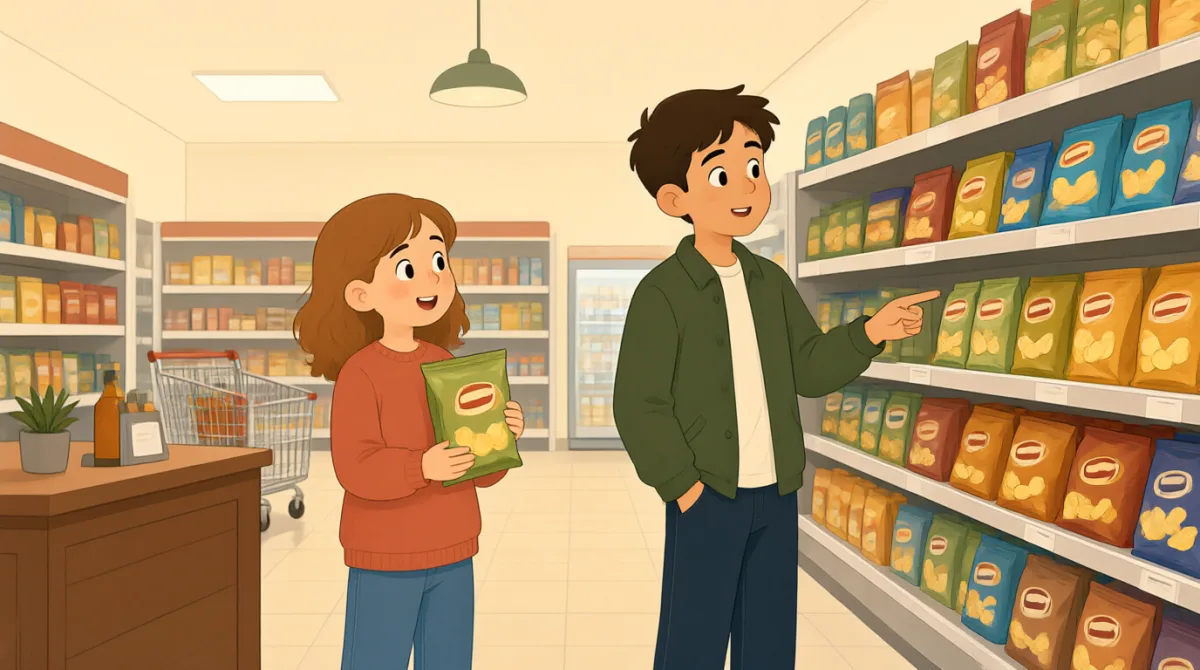

Excuse me, where are the snacks?
Entschuldigung, wo finde ich die Snacks?

They are in aisle three, on your left.
Gang drei, links von dir.
Thanks! Are the chips there too?
Danke! Gibt es dort auch Chips?
Yes, they are on the top shelf.
Ja, sie sind im obersten Regal.
Great. I want a bag of chips.
Super. Ich möchte eine Tüte Chips.
The chips are right next to the crackers.
Die Chips sind direkt neben den Crackern.
Wortschatz7
- Excuse meExcuse me
This polite phrase gets someone's attention before you ask a question. Use it when you need help in a store.
Mit dieser höflichen Wendung machst du jemanden auf dich aufmerksam, bevor du eine Frage stellst. Du kannst sie verwenden, wenn du in einem Geschäft Hilfe brauchst.
- where are the snacks?where are the snacks?
Use this question to ask where snacks are. You can replace “the snacks” with another item.
Mit dieser Frage erkundigst du dich, wo die Snacks sind. Du kannst „the snacks“ durch einen anderen Artikel ersetzen.
- aisle threeaisle three
An aisle is a path between store shelves. Use “aisle” with a number to find things in a store.
Ein Gang ist ein Weg zwischen den Regalen im Geschäft. Mit „aisle“ und einer Zahl kannst du sagen, wo du etwas findest.
- on your lefton your left
This means something is to the left side of you. Use it to tell someone where to look.
Das bedeutet, dass sich etwas links von dir befindet. Mit dieser Wendung kannst du jemandem sagen, wo er suchen soll.
- top shelftop shelf
The top shelf is the highest shelf. Use “on the top shelf” to say where an item is.
Das oberste Regal ist das höchste Regal. Mit „on the top shelf“ sagst du, wo sich ein Artikel befindet.
- a bag of chipsa bag of chips
This means one bag that contains chips. Use “a bag of” before a snack or other item sold in a bag.
Damit ist eine Tüte gemeint, in der Chips sind. Vor einen Snack oder einen anderen Artikel, der in einer Tüte verkauft wird, kannst du „a bag of“ setzen.
- right next toright next to
This means very close beside something. Use “right next to” to describe where an item is.
Das bedeutet, dass etwas direkt neben etwas anderem ist. Mit „right next to“ kannst du beschreiben, wo sich ein Artikel befindet.
Wichtige Sätze6
- 1
Excuse me, where are the snacks?
Entschuldigung, wo finde ich die Snacks?
This is a polite way to ask for help finding something. You can reuse “Where are the [items]?” to ask about other products.
So kannst du höflich um Hilfe bitten, wenn du etwas suchst. Die Frage „Where are the [items]?“ kannst du auch für andere Produkte verwenden.
- 2
They are in aisle three, on your left.
Gang drei, links von dir.
This sentence gives both an aisle number and a direction. Use “They are in aisle [number], on your [left/right]” to guide someone.
Dieser Satz nennt sowohl eine Gangnummer als auch eine Richtung. Mit „They are in aisle [number], on your [left/right]“ kannst du jemandem den Weg zeigen.
- 3
Are the chips there too?
Gibt es dort auch Chips?
Use this question to ask if another item is in the same place. Replace “the chips” with the item you want to find.
Mit dieser Frage erkundigst du dich, ob es einen anderen Artikel am selben Ort gibt. Ersetze „the chips“ durch den Artikel, den du suchst.
- 4
Yes, they are on the top shelf.
Ja, sie sind im obersten Regal.
This gives a simple answer and tells where the item is. You can replace “on the top shelf” with another location.
Damit gibst du eine kurze Antwort und sagst, wo sich der Artikel befindet. Du kannst „on the top shelf“ durch eine andere Ortsangabe ersetzen.
- 5
Great. I want a bag of chips.
Super. Ich möchte eine Tüte Chips.
Use “I want a bag of [snack]” to say what you would like. It is a simple way to talk about what you want to buy.
Mit „I want a bag of [snack]“ sagst du, was du gern hättest. So kannst du einfach sagen, was du kaufen möchtest.
- 6
The chips are right next to the crackers.
Die Chips sind direkt neben den Crackern.
This sentence explains that one item is beside another. Use “The [item] is right next to the [other item]” to describe locations.
Dieser Satz erklärt, dass sich ein Artikel neben einem anderen befindet. Mit „The [item] is right next to the [other item]“ kannst du beschreiben, wo sich Dinge befinden.