Asking Where the Snacks Are
Pytanie o przekąski
Emma asks Jack where the snacks are. He shows her the snack aisle, and she picks a bag of chips.
Emma pyta Jacka, gdzie są przekąski. Jack pokazuje jej alejkę z przekąskami, a ona wybiera paczkę chipsów.
Dialog6
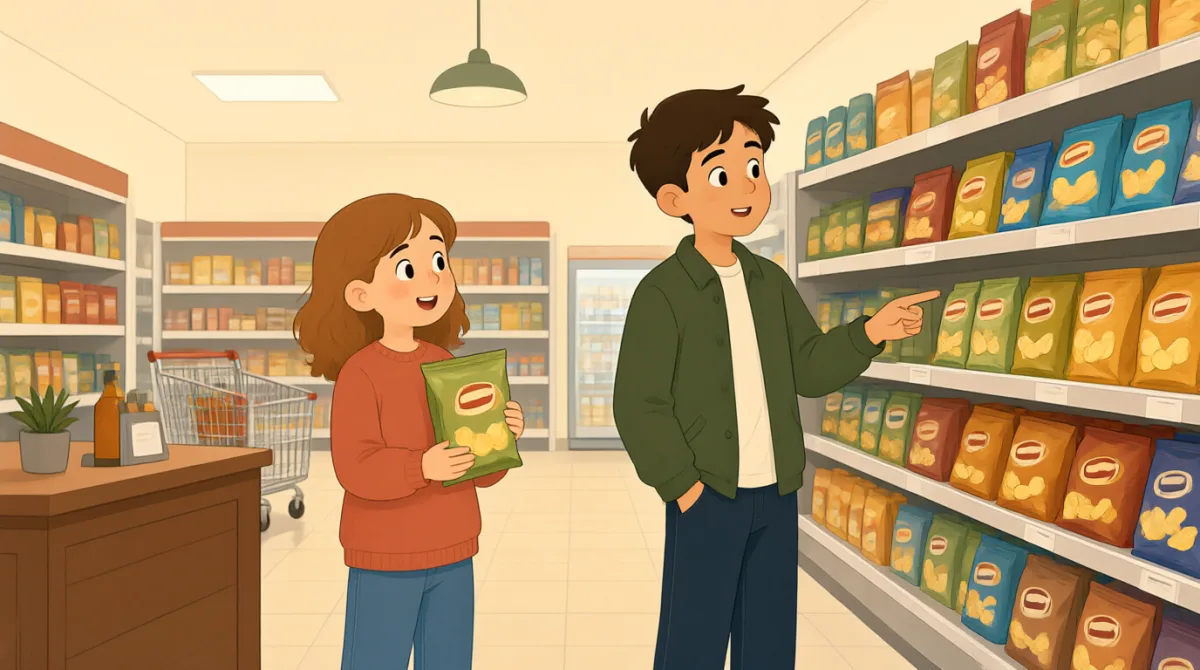

Excuse me, where are the snacks?
Przepraszam, gdzie są przekąski?

They are in aisle three, on your left.
W alejce numer trzy, po lewej stronie.
Thanks! Are the chips there too?
Dzięki! Chipsy też tam są?
Yes, they are on the top shelf.
Tak, są na górnej półce.
Great. I want a bag of chips.
Świetnie. Chcę paczkę chipsów.
The chips are right next to the crackers.
Chipsy są tuż obok krakersów.
Słownictwo7
- Excuse mePrzepraszam
This polite phrase gets someone's attention before you ask a question. Use it when you need help in a store.
Tego uprzejmego zwrotu używasz, żeby zwrócić czyjąś uwagę, zanim zadasz pytanie. Przyda się, gdy potrzebujesz pomocy w sklepie.
- where are the snacks?gdzie są przekąski?
Use this question to ask where snacks are. You can replace “the snacks” with another item.
Tego pytania używasz, żeby zapytać, gdzie są przekąski. Możesz zastąpić “the snacks” nazwą innego produktu.
- aisle threealejka numer trzy
An aisle is a path between store shelves. Use “aisle” with a number to find things in a store.
Alejka to przejście między sklepowymi półkami. Użyj “aisle” z numerem, żeby dowiedzieć się, gdzie coś znaleźć w sklepie.
- on your leftpo lewej stronie
This means something is to the left side of you. Use it to tell someone where to look.
To znaczy, że coś znajduje się po twojej lewej stronie. Użyj tego zwrotu, żeby powiedzieć komuś, gdzie ma szukać.
- top shelfgórna półka
The top shelf is the highest shelf. Use “on the top shelf” to say where an item is.
Górna półka to najwyższa półka. Użyj “on the top shelf”, żeby powiedzieć, gdzie znajduje się dany produkt.
- a bag of chipspaczka chipsów
This means one bag that contains chips. Use “a bag of” before a snack or other item sold in a bag.
To jedna paczka, w której są chipsy. Użyj “a bag of” przed nazwą przekąski lub innego produktu sprzedawanego w paczce.
- right next totuż obok
This means very close beside something. Use “right next to” to describe where an item is.
To znaczy, że coś znajduje się bardzo blisko czegoś innego. Użyj “right next to”, żeby opisać, gdzie coś się znajduje.
Kluczowe zdania6
- 1
Excuse me, where are the snacks?
Przepraszam, gdzie są przekąski?
This is a polite way to ask for help finding something. You can reuse “Where are the [items]?” to ask about other products.
To uprzejmy sposób, żeby poprosić o pomoc w znalezieniu czegoś. Możesz użyć wzoru “Where are the [items]?”, pytając o inne produkty.
- 2
They are in aisle three, on your left.
W alejce numer trzy, po lewej stronie.
This sentence gives both an aisle number and a direction. Use “They are in aisle [number], on your [left/right]” to guide someone.
To zdanie podaje numer alejki i kierunek. Użyj wzoru “They are in aisle [number], on your [left/right]”, żeby wskazać komuś drogę.
- 3
Are the chips there too?
Chipsy też tam są?
Use this question to ask if another item is in the same place. Replace “the chips” with the item you want to find.
Tego pytania użyj, żeby zapytać, czy inny produkt znajduje się w tym samym miejscu. Zastąp “the chips” nazwą produktu, którego szukasz.
- 4
Yes, they are on the top shelf.
Tak, są na górnej półce.
This gives a simple answer and tells where the item is. You can replace “on the top shelf” with another location.
To prosta odpowiedź, która mówi, gdzie znajduje się dany produkt. Możesz zastąpić “on the top shelf” innym określeniem miejsca.
- 5
Great. I want a bag of chips.
Świetnie. Chcę paczkę chipsów.
Use “I want a bag of [snack]” to say what you would like. It is a simple way to talk about what you want to buy.
Użyj “I want a bag of [snack]”, żeby powiedzieć, na co masz ochotę. To prosty sposób, by powiedzieć, co chcesz kupić.
- 6
The chips are right next to the crackers.
Chipsy są tuż obok krakersów.
This sentence explains that one item is beside another. Use “The [item] is right next to the [other item]” to describe locations.
To zdanie wyjaśnia, że jeden produkt znajduje się obok drugiego. Użyj wzoru “The [item] is right next to the [other item]”, żeby opisać, gdzie coś się znajduje.