Getting Gloves and Bags
领取手套和垃圾袋
At the park, Grace gives Emma and Mia gloves and bags. She explains where to put the trash.
在公园里,Grace 给 Emma 和 Mia 手套和垃圾袋。她说明垃圾要放在哪里。
对话8
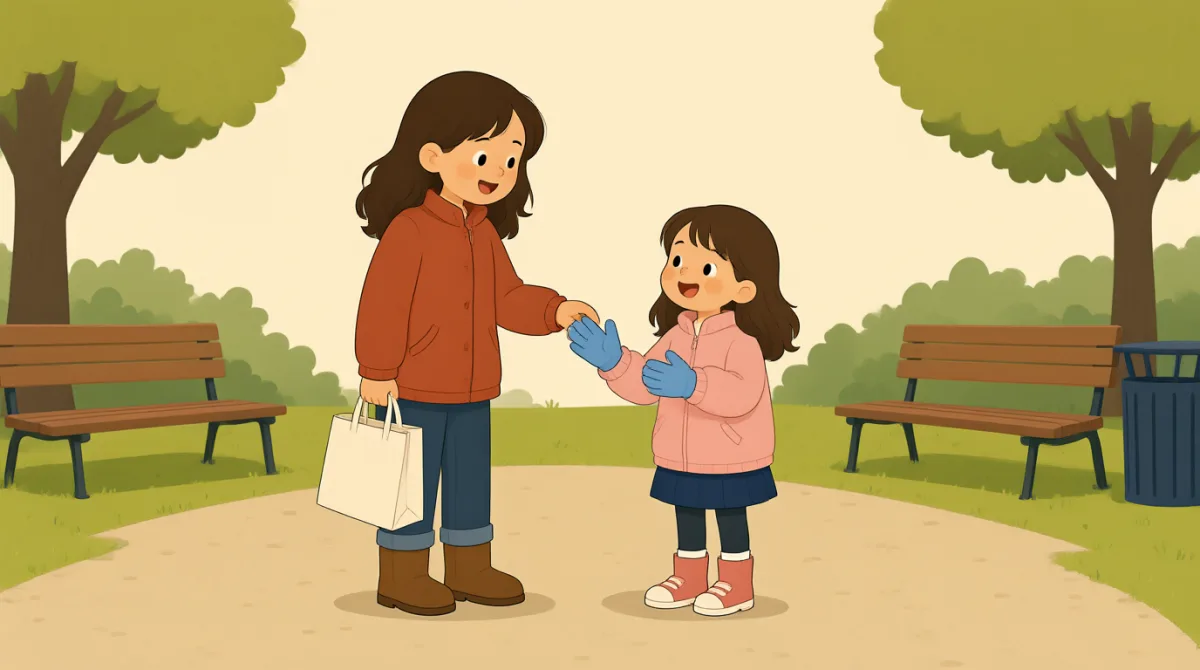

Here are your gloves and bags. Please put on the gloves before you start.
这是你们的手套和袋子。开始之前请先戴上手套。

Thanks, Grace. Where should we put the trash when our bags are full?
谢谢你,Grace。袋子装满后,我们应该把垃圾放在哪里?
Leave full bags by the park entrance. We’ll collect them there later.
把装满的袋子放在公园入口处。我们之后会在那里收走。

Should we pick up broken glass too, or leave it for someone else?
我们也要捡碎玻璃吗,还是留给别人处理?
Please don’t touch broken glass. Tell me, and I’ll bring a special container.
请不要碰碎玻璃。告诉我一声,我会拿来一个专用容器。
Got it. Are there any areas we should clean first?
明白了。有没有哪个区域需要我们先清理?
Start along the paths near the playground. Watch for people walking by.
先清理游乐场附近的小路。注意路过的人。
Okay, we’ll take these bags and start near the playground.
好的,我们拿上这些袋子,从游乐场附近开始。
词汇8
- put on the gloves戴上手套
To put on the gloves means to wear them on your hands. You can use “put on” for clothes and accessories.
“put on the gloves”是指把手套戴在手上。“put on”也可以用于穿衣服或佩戴配饰。
- bags are full袋子装满了
This means there is no more space in the bags. You can say “My bag is full” when it cannot hold anything else.
这表示袋子里没有空余空间了。袋子再也装不下东西时,可以说“My bag is full”。
- park entrance公园入口
The park entrance is the place where people enter the park. You can use this phrase to give someone a meeting place.
“park entrance”指人们进入公园的地方。你可以用这个短语告诉别人在哪里碰面。
- pick up捡起
Here, “pick up” means to collect something from the ground. You can also say “pick up litter” when cleaning outside.
这里的“pick up”指把地上的东西捡起来。清理户外环境时,也可以说“pick up litter”。
- broken glass碎玻璃
Broken glass is glass that has cracked into pieces. It can be dangerous, so people should not touch it.
“broken glass”指碎成小块的玻璃。碎玻璃很危险,所以不要用手碰。
- special container专用容器
A special container is a particular box or holder made for a certain purpose. You can use “container” for something that holds or carries items.
“special container”指为某种特定用途制作的箱子或容器。你可以用“container”来指装东西或搬运物品的容器。
- walking by路过
“Walking by” means passing near a place on foot. You can use it to talk about people moving past you.
“walking by”指步行经过某个地方。你可以用它来描述有人从你身边走过。
- near the playground在游乐场附近
This means close to the playground. You can use “near” to say that one place is not far from another.
这表示离游乐场很近。你可以用“near”来表示一个地方离另一个地方不远。
重点句子8
- 1
Please put on the gloves before you start.
开始之前请先戴上手套。
This is a polite way to give someone an instruction. Use “Please” to make a request sound friendly.
这是一种礼貌地告诉别人该做什么的说法。加上“Please”能让请求听起来更友好。
- 2
Where should we put the trash when our bags are full?
我们的袋子装满后,应该把垃圾放在哪里?
This is a useful way to ask where something belongs. Replace “the trash” with another item to ask where to put it.
这是询问某样东西应该放在哪里的一种实用说法。把“the trash”换成其他物品,就可以询问该把那样东西放在哪里。
- 3
Leave full bags by the park entrance.
把装满的袋子放在公园入口处。
This gives a clear instruction about where to leave something. You can replace “full bags” and “the park entrance” with other items and places.
这句话清楚地说明了该把东西放在哪里。你可以把“full bags”和“the park entrance”换成其他物品和地点。
- 4
Please don’t touch broken glass.
请不要碰碎玻璃。
This is a polite but clear warning. Use “Please don’t” to ask someone not to do something.
这是一种礼貌但明确的提醒。用“Please don’t”请别人不要做某事。
- 5
Tell me, and I’ll bring a special container.
告诉我一声,我会拿来一个专用容器。
This offers help and explains what you will do next. Use “I’ll” to talk about a future action or decision.
这句话是在主动帮忙,并说明接下来会做什么。用“I’ll”来表达将要做的事或已经决定要做的事。
- 6
Are there any areas we should clean first?
有没有哪个区域需要我们先清理?
This is a useful way to ask which task or place to begin with. Replace “areas we should clean” with another activity to ask what to do first.
这是一种实用的问法,可以询问应该先做哪项任务或先去哪个地方。把“areas we should clean”换成其他活动,就可以询问应该先做什么。
- 7
Watch for people walking by.
留意路过的人。
This reminds someone to be careful and notice people nearby. Use “Watch for” to warn someone to look out for something.
这句话提醒别人小心,并注意附近的人。用“Watch for”提醒别人留意某样东西或某种情况。
- 8
Okay, we’ll take these bags and start near the playground.
好的,我们拿上这些袋子,从游乐场附近开始。
This confirms a plan and says what will happen next. Use “we’ll” to describe a future action you have decided on.
这句话确认了计划,并说明接下来要做什么。用“we’ll”来描述已经决定要做的将来行动。