Unpacking and Sorting - The Overwhelm
แกะกล่องและคัดแยก — ชิ้นส่วนเยอะจนมึน
The couple opens the IKEA box to find an overwhelming number of parts and screws, initiating the first step of sorting and identifying everything according to the instruction manual. One partner might be more methodical, while the other feels daunted by the sheer volume of pieces.
คู่รักเปิดกล่อง IKEA แล้วพบว่ามีชิ้นส่วนและสกรูจำนวนมากจนชวนให้ปวดหัว จึงเริ่มคัดแยกและตรวจดูชิ้นส่วนแต่ละชิ้นตามคู่มือประกอบ คนหนึ่งอาจเป็นคนละเอียดเป็นระบบ ส่วนอีกคนรู้สึกท้อกับจำนวนชิ้นส่วนที่กองอยู่ตรงหน้า
บทสนทนา8
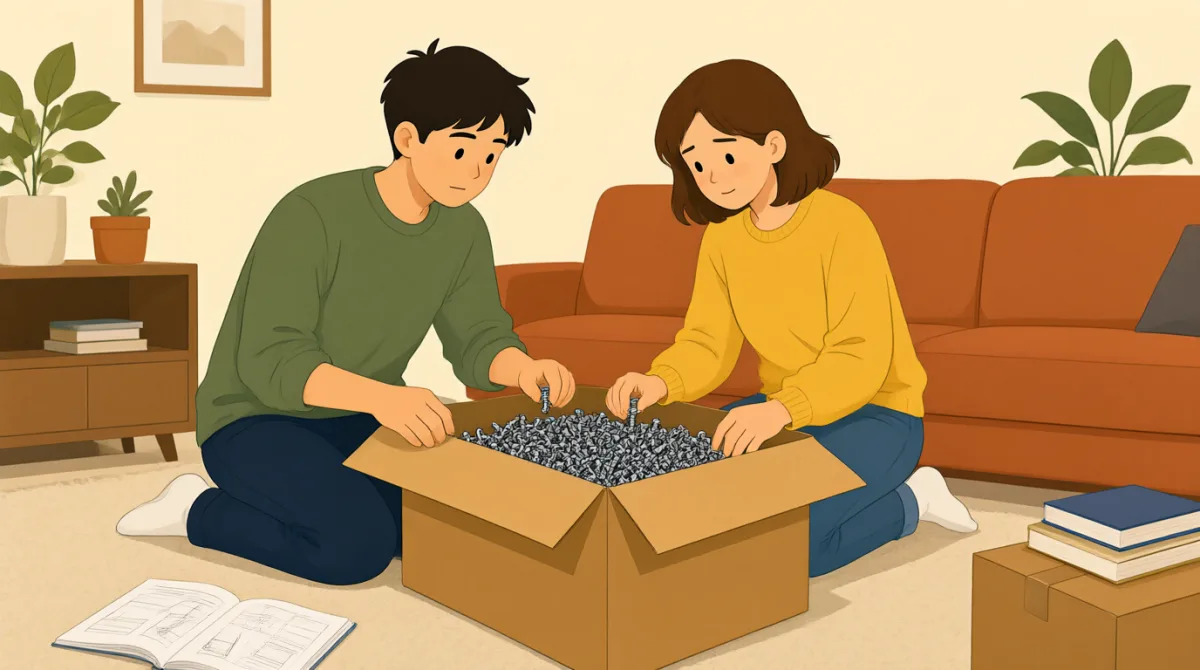

Okay, box is open! Wow… that is a lot of pieces. Where do we even begin?
โอเค เปิดกล่องแล้ว! ว้าว… ชิ้นส่วนเยอะมาก เราจะเริ่มตรงไหนกันดีเนี่ย

Right. Deep breaths. First things first, let's pull out the instruction manual. We need to identify all the parts and make sure nothing's missing.
นั่นสิ หายใจลึก ๆ ก่อน เอาละ อย่างแรกเลย หาคู่มือประกอบออกมาก่อน เราต้องเช็กว่ามีชิ้นส่วนอะไรบ้าง แล้วดูว่าขาดอะไรไปหรือเปล่า
Ugh, this looks like a puzzle. One hundred identical-looking wooden dowels. And these tiny screws… there are so many different kinds!
โอย นี่เหมือนกำลังต่อจิ๊กซอว์เลย เดือยไม้หน้าตาเหมือนกันตั้งร้อยอัน แถมสกรูจิ๋วพวกนี้อีก… มีตั้งหลายแบบแน่ะ!
I know, it's a bit daunting. How about you take the large pieces and match them to the diagram on page two. I'll sort out all the hardware – the screws, nuts, and bolts – into little piles.
เข้าใจเลย มันดูน่าท้ออยู่เหมือนกัน เธอเอาชิ้นใหญ่ ๆ ไปเทียบกับภาพในหน้าสองดีไหม เดี๋ยวฉันแยกอุปกรณ์ยึดพวกสกรู นอต แล้วก็โบลต์เป็นกองเล็ก ๆ เอง
Sounds like a plan. So, these long ones are ‘Part A’, and the short, thin ones are ‘Part B’, got it. Wait, what about these oddly shaped ones? They're not on the first page.
ฟังดูดี งั้นอันยาว ๆ นี่คือ ‘Part A’ ส่วนอันสั้นบางคือ ‘Part B’ เข้าใจแล้ว เดี๋ยวนะ แล้วอันทรงแปลก ๆ พวกนี้ล่ะ ไม่เห็นมีในหน้าแรกเลย
Hmm, let me check. Ah, those must be for the drawers later on. The manual usually introduces parts as they're needed. See? Page three starts with the drawer components.
อืม ขอฉันดูก่อน อ๋อ พวกนั้นคงเอาไว้ใช้กับลิ้นชักทีหลังน่ะ ปกติคู่มือจะบอกเรื่องชิ้นส่วนตอนที่ต้องใช้พอดี เห็นไหม หน้า 3 เริ่มด้วยส่วนประกอบของลิ้นชักแล้ว
Right, okay. This is going to take a while. I feel like we need a dedicated sorting area just for the screws.
อ๋อ โอเค งานนี้คงใช้เวลาสักพักเลย รู้สึกว่าเราต้องจัดพื้นที่แยกสกรูโดยเฉพาะแล้วล่ะ
Agreed. I'll grab some small bowls or cups from the kitchen. That always makes it easier. Don't worry, we'll get through this. It's always the sorting that feels the most overwhelming.
เห็นด้วย เดี๋ยวฉันไปหยิบถ้วยหรือชามใบเล็ก ๆ จากครัวมา แบบนั้นช่วยให้แยกง่ายขึ้นเยอะ ไม่ต้องห่วงนะ เดี๋ยวเราก็จัดการได้ ช่วงคัดแยกนี่แหละที่ชวนให้รู้สึกว่ามันเยอะจนรับมือไม่ไหวที่สุด
คำศัพท์8
- piecesชิ้นส่วน
Small parts or components of something, like furniture. Use it when talking about assembling or building items, e.g., 'There are many pieces in the box.'
ส่วนเล็ก ๆ ที่ประกอบกันเป็นสิ่งของ เช่น เฟอร์นิเจอร์ ใช้พูดถึงการประกอบหรือสร้างสิ่งต่าง ๆ เช่น 'There are many pieces in the box.' (ในกล่องมีชิ้นส่วนเยอะมาก)
- instruction manualคู่มือประกอบ
A booklet with steps and pictures to guide how to assemble or use something. Common in DIY tasks like IKEA furniture; say 'Read the instruction manual first.'
หนังสือเล่มเล็กที่มีขั้นตอนและภาพช่วยแนะนำวิธีประกอบหรือใช้งานสิ่งของ มักพบในงาน DIY เช่น เฟอร์นิเจอร์ IKEA ลองพูดว่า 'Read the instruction manual first.' (อ่านคู่มือประกอบก่อน)
- dauntingน่าท้อ / ชวนให้รู้สึกหนักใจ
Something that feels scary or overwhelming because it's difficult. Useful for expressing hesitation, like 'The task looks daunting.'
ใช้บอกว่าสิ่งหนึ่งดูยากจนน่ากลัวหรือทำให้รู้สึกหนักใจ เหมาะเมื่ออยากบอกว่ายังลังเล เช่น 'The task looks daunting.' (งานนี้ดูน่าท้อจัง)
- hardwareอุปกรณ์ยึด
Metal parts like screws and bolts used in building. In this context, it means small fasteners for furniture; e.g., 'Sort the hardware into piles.'
ชิ้นส่วนโลหะอย่างสกรูและโบลต์ที่ใช้ประกอบสิ่งของ ในบริบทนี้หมายถึงอุปกรณ์ชิ้นเล็ก ๆ สำหรับยึดเฟอร์นิเจอร์ เช่น 'Sort the hardware into piles.' (แยกอุปกรณ์ยึดออกเป็นกอง ๆ)
- diagramภาพแผนผัง
A simple drawing or picture that shows how parts fit together. Helpful in instructions; say 'Match the parts to the diagram.'
ภาพวาดง่าย ๆ ที่แสดงว่าชิ้นส่วนต่าง ๆ ประกอบเข้าด้วยกันอย่างไร มีประโยชน์ในคู่มือ เช่น 'Match the parts to the diagram.' (เทียบชิ้นส่วนกับภาพแผนผัง)
- componentsส่วนประกอบ
Individual parts that make up a whole item. Use in technical or assembly contexts, like 'Drawer components are on page three.'
ชิ้นส่วนแต่ละชิ้นที่รวมกันเป็นสิ่งของหนึ่งชิ้น ใช้ในบริบททางเทคนิคหรือการประกอบ เช่น 'Drawer components are on page three.' (ส่วนประกอบของลิ้นชักอยู่ในหน้าสาม)
- overwhelmingมากจนรับมือไม่ไหว
Too much to handle easily, causing stress. Common for big tasks; e.g., 'The number of pieces is overwhelming.'
มีมากเกินกว่าจะจัดการได้ง่าย ๆ จนทำให้เครียด มักใช้กับงานใหญ่ ๆ เช่น 'The number of pieces is overwhelming.' (ชิ้นส่วนมีเยอะจนรับมือไม่ไหว)
- sortingการคัดแยก
Organizing items into groups or categories. Practical for tasks like this; say 'Start with sorting the screws.'
การจัดสิ่งของเป็นกลุ่มหรือประเภทต่าง ๆ มีประโยชน์กับงานแบบนี้ เช่น 'Start with sorting the screws.' (เริ่มจากคัดแยกสกรูก่อน)
ประโยคสำคัญ8
- 1
Where do we even begin?
เราจะเริ่มตรงไหนกันดีเนี่ย
This expresses confusion or uncertainty about starting a task. Useful for collaborative situations; it's informal and shows overwhelm. Grammar: 'Even' adds emphasis for surprise.
ประโยคนี้ใช้บอกว่ารู้สึกสับสนหรือไม่แน่ใจว่าจะเริ่มงานตรงไหน เหมาะกับการทำงานร่วมกัน เป็นภาษากันเองและสื่อว่ารู้สึกว่างานเยอะจนตั้งตัวไม่ถูก ในทางไวยากรณ์ 'Even' ใช้เน้นความรู้สึกแปลกใจ
- 2
First things first, let's pull out the instruction manual.
เอาละ อย่างแรกเลย หาคู่มือประกอบออกมาก่อน
Prioritizes the most important step first. Great for organizing work; use when guiding others. Grammar: Imperative 'let's' suggests teamwork.
ใช้บอกว่าควรจัดการสิ่งสำคัญที่สุดก่อน เหมาะกับการวางแผนงานหรือแนะนำคนอื่น ในทางไวยากรณ์ 'let's' เป็นรูปชวนให้ทำบางอย่างด้วยกัน
- 3
This looks like a puzzle.
นี่เหมือนกำลังต่อจิ๊กซอว์เลย
Compares a complicated task to a puzzle, meaning it's confusing. Helpful for everyday complaints; informal and relatable in DIY scenarios.
เปรียบงานที่ซับซ้อนกับการต่อจิ๊กซอว์ เพื่อสื่อว่ามันชวนให้งง เหมาะกับการบ่นในชีวิตประจำวัน เป็นภาษากันเองและเข้ากับสถานการณ์ DIY
- 4
How about you take the large pieces and match them to the diagram?
เธอเอาชิ้นใหญ่ ๆ ไปเทียบกับภาพแผนผังดีไหม
Suggests dividing tasks politely. Useful for teamwork; 'How about' softens suggestions. Grammar: Imperative form with 'you' for assigning roles.
ใช้เสนอให้แบ่งงานกันอย่างนุ่มนวล เหมาะกับการทำงานเป็นทีม โดย 'How about' ช่วยให้ข้อเสนอฟังดูไม่แข็ง ในทางไวยากรณ์ รูปคำสั่งที่ใช้ 'you' เป็นการมอบหมายหน้าที่ให้คู่สนทนา
- 5
Sounds like a plan.
ฟังดูดี
Agrees with a suggestion positively. Common in casual conversations to show approval; quick and efficient for moving forward.
ใช้ตอบรับข้อเสนอในเชิงบวก เป็นสำนวนที่พบบ่อยในการคุยกันแบบสบาย ๆ เพื่อแสดงว่าเห็นด้วย สั้น กระชับ และช่วยให้ไปต่อได้เลย
- 6
Those must be for the drawers later on.
พวกนั้นคงเอาไว้ใช้กับลิ้นชักทีหลังน่ะ
Makes a logical guess about purpose. Useful for problem-solving; 'must be' expresses strong inference based on context.
ใช้คาดเดาอย่างมีเหตุผลว่าสิ่งนั้นมีไว้ทำอะไร เหมาะกับการแก้ปัญหา โดย 'must be' ใช้แสดงข้อสรุปที่ค่อนข้างมั่นใจจากบริบท
- 7
This is going to take a while.
งานนี้คงใช้เวลาสักพักเลย
Predicts that something will require time. Practical for setting expectations; future continuous 'is going to take' shows ongoing action.
ใช้คาดการณ์ว่าสิ่งหนึ่งต้องใช้เวลา เหมาะสำหรับบอกให้อีกฝ่ายเตรียมใจ ในทางไวยากรณ์ 'is going to take' ใช้พูดถึงสิ่งที่จะเกิดขึ้นและดำเนินต่อไป
- 8
Don't worry, we'll get through this.
ไม่ต้องห่วงนะ เดี๋ยวเราก็จัดการได้
Reassures someone during a challenge. Encouraging and supportive; use in tough situations. Grammar: 'We'll' is short for 'we will,' future simple for promise.
ใช้ปลอบใจและให้กำลังใจใครสักคนระหว่างเจอเรื่องท้าทาย เหมาะกับสถานการณ์ที่ยากลำบาก ในทางไวยากรณ์ 'We'll' ย่อมาจาก 'we will' ซึ่งเป็นรูปอนาคตอย่างง่าย ใช้ให้คำมั่นหรือให้ความมั่นใจ