First Piano Lesson Introduction
แนะนำบทเรียนเปียโนครั้งแรก
A student has their first piano lesson, meeting the teacher, learning about posture, and identifying basic keys.
นักเรียนมาเรียนเปียโนเป็นครั้งแรก พบกับครู เรียนรู้เรื่องท่านั่ง และทำความรู้จักกับคีย์พื้นฐาน
บทสนทนา9
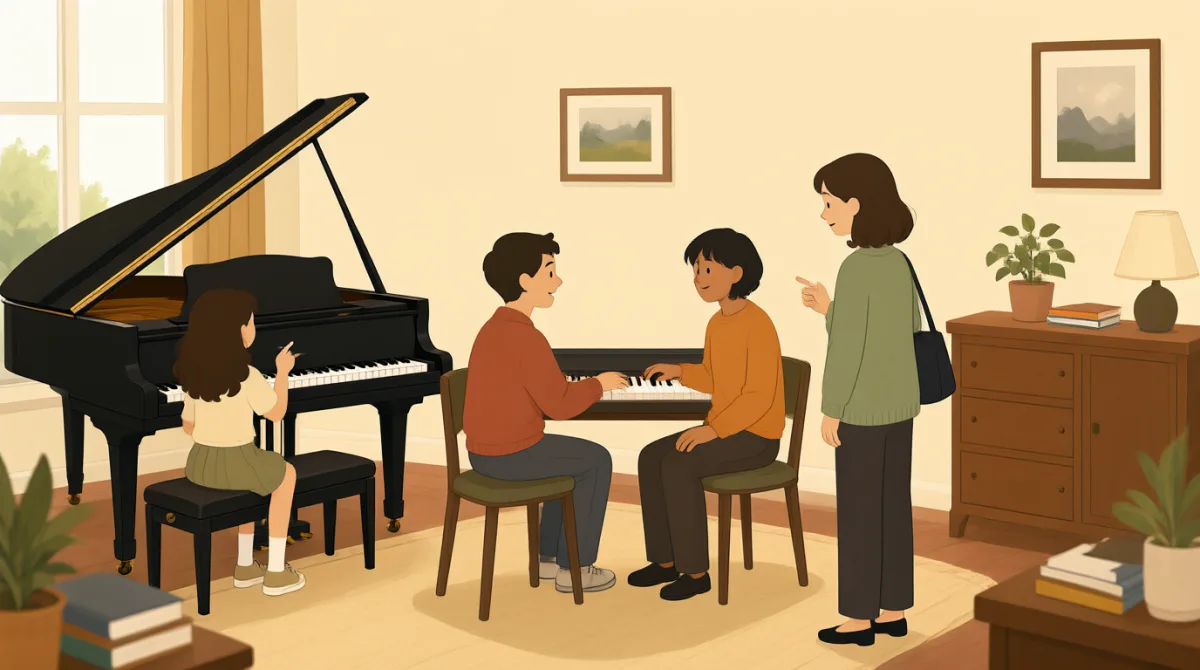

Welcome! Are you excited for your first piano lesson?
ยินดีต้อนรับ! ตื่นเต้นกับการเรียนเปียโนครั้งแรกไหม?

Yes, I am! I've always wanted to learn the piano.
ตื่นเต้นสิ! ฉันอยากเรียนเปียโนมาตลอดเลย
That's great to hear! Let's start with proper posture. Sit up straight, shoulders relaxed, and make sure your forearms are parallel to the floor.
ดีเลย! เรามาเริ่มจากท่านั่งที่ถูกต้องกันนะ นั่งหลังตรง ผ่อนคลายไหล่ แล้วจัดให้ท่อนแขนขนานกับพื้น
Like this?
แบบนี้เหรอ?
Perfect! Now, let's look at the keys. Do you see the pattern of two black keys and three black keys?
เยี่ยมเลย! ทีนี้มาดูคีย์กัน เห็นรูปแบบคีย์ดำสองคีย์กับสามคีย์ไหม?
Yes, I do.
เห็นแล้ว
Great! The white key to the left of every two black keys is always C. Can you find all the Cs on the piano?
ดีมาก! คีย์สีขาวที่อยู่ทางซ้ายของคีย์ดำทุกกลุ่มที่มีสองคีย์คือ C เสมอ ลองหาคีย์ C ทุกตัวบนเปียโนดูได้ไหม?
Let me try... Is this one C, and this one?
ขอลองดูก่อนนะ... อันนี้เป็น C แล้วอันนี้ล่ะ?
That's right! You've got it. We'll work on finger placement next. You're doing great for your first lesson!
ใช่เลย! เข้าใจแล้วนี่ เดี๋ยวเราจะฝึกวางนิ้วกันต่อ เธอทำได้ดีมากสำหรับบทเรียนแรก!
คำศัพท์6
- excitedตื่นเต้น
Feeling very happy and enthusiastic about something, like starting a new activity. Use it to express positive emotions, e.g., 'I'm excited about the trip.'
รู้สึกมีความสุขและกระตือรือร้นมากกับบางสิ่ง เช่น การเริ่มทำกิจกรรมใหม่ ใช้แสดงความรู้สึกในแง่บวก เช่น 'I'm excited about the trip.' (ฉันตื่นเต้นกับทริปนี้)
- postureท่าทาง
The way you hold your body when sitting or standing. Important in music lessons to avoid strain, e.g., 'Good posture helps you play better.'
ลักษณะการวางร่างกายเวลานั่งหรือยืน ในการเรียนดนตรี ท่าทางที่ถูกต้องช่วยป้องกันการเมื่อยล้า เช่น 'Good posture helps you play better.' (ท่าทางที่ดีช่วยให้เล่นได้ดีขึ้น)
- relaxedผ่อนคลาย
Calm and not tense. In lessons, it means keeping your body loose for better control, e.g., 'Keep your hands relaxed.'
สงบและไม่เกร็ง ในการเรียนหมายถึงการปล่อยร่างกายให้สบาย เพื่อควบคุมการเคลื่อนไหวได้ดีขึ้น เช่น 'Keep your hands relaxed.' (ผ่อนคลายมือไว้นะ)
- parallelขนาน
Two lines or surfaces that are always the same distance apart and never meet. Here, it describes forearm position level with the floor for proper piano playing.
เส้นหรือพื้นผิวสองส่วนที่อยู่ห่างกันเท่าเดิมตลอดและไม่มีวันตัดกัน ในที่นี้ใช้อธิบายตำแหน่งท่อนแขนที่อยู่ระดับเดียวกับพื้น เพื่อให้เล่นเปียโนได้ถูกท่า
- patternรูปแบบ
A repeated design or arrangement. On the piano, it refers to the repeating groups of black and white keys to help identify notes.
ลักษณะหรือการจัดเรียงที่เกิดซ้ำ บนเปียโนหมายถึงกลุ่มคีย์สีดำและสีขาวที่เรียงซ้ำกัน ซึ่งช่วยให้ระบุตัวโน้ตได้
- keysคีย์
The buttons on a piano or keyboard that you press to play notes. There are white and black keys in a specific order.
ปุ่มบนเปียโนหรือคีย์บอร์ดที่กดเพื่อเล่นโน้ต มีทั้งคีย์สีขาวและสีดำเรียงตามลำดับเฉพาะ
ประโยคสำคัญ6
- 1
Are you excited for your first piano lesson?
ตื่นเต้นกับการเรียนเปียโนครั้งแรกไหม?
This is a question to show interest and build rapport. Use 'Are you excited for [event]?' to ask about someone's feelings. 'For' is used with future events; it's useful for starting conversations in classes or activities.
ประโยคคำถามนี้ใช้แสดงความสนใจและช่วยสร้างความสนิทสนม ใช้ 'Are you excited for [event]?' เพื่อถามความรู้สึกของใครสักคน โดยใช้ 'for' กับเหตุการณ์ที่จะเกิดขึ้นในอนาคต เหมาะสำหรับเริ่มบทสนทนาในชั้นเรียนหรือกิจกรรมต่าง ๆ
- 2
I've always wanted to learn the piano.
ฉันอยากเรียนเปียโนมาตลอดเลย
Expresses a long-term desire using present perfect 'I've always wanted' for ongoing wishes. Useful for sharing personal goals, like in introductions or hobby discussions. Grammar: Present perfect for experiences up to now.
ประโยคนี้บอกความปรารถนาที่มีมานาน โดยใช้ present perfect ในรูป 'I've always wanted' เพื่อพูดถึงความต้องการที่มีต่อเนื่องมาจนถึงตอนนี้ เหมาะสำหรับเล่าเป้าหมายส่วนตัว เช่น ตอนแนะนำตัวหรือพูดคุยเรื่องงานอดิเรก ไวยากรณ์: ใช้ present perfect กับประสบการณ์หรือความรู้สึกที่ดำเนินมาจนถึงปัจจุบัน
- 3
Sit up straight, shoulders relaxed, and make sure your forearms are parallel to the floor.
นั่งหลังตรง ผ่อนคลายไหล่ แล้วจัดให้ท่อนแขนขนานกับพื้น
Imperative instructions for posture. Use commands like 'Sit up straight' in teaching situations. 'Make sure' means ensure something happens. Practical for giving advice on body position in sports or music.
นี่คือคำสั่งให้จัดท่าทาง ใช้คำสั่งอย่าง 'Sit up straight' (นั่งหลังตรง) เมื่อต้องสอนใครสักคน ส่วน 'Make sure' หมายถึงทำให้แน่ใจว่าอะไรบางอย่างเกิดขึ้น ใช้ได้จริงเมื่อต้องแนะนำท่าทางในการเล่นกีฬาหรือดนตรี
- 4
Do you see the pattern of two black keys and three black keys?
เห็นรูปแบบคีย์ดำสองคีย์กับสามคีย์ไหม?
A yes/no question to check understanding. 'Do you see' asks about observation. Useful in lessons to confirm if someone notices a feature. The phrase describes piano key arrangement, helping learners visualize repeats.
ประโยคคำถามแบบตอบใช่หรือไม่ใช้ตรวจสอบความเข้าใจ 'Do you see' ใช้ถามว่าอีกฝ่ายสังเกตเห็นหรือไม่ เหมาะกับการถามในบทเรียนว่าเขาเห็นลักษณะบางอย่างไหม ประโยคนี้พูดถึงการเรียงคีย์เปียโน ช่วยให้ผู้เรียนมองเห็นรูปแบบที่เกิดซ้ำ
- 5
The white key to the left of every two black keys is always C.
คีย์สีขาวที่อยู่ทางซ้ายของคีย์ดำทุกกลุ่มที่มีสองคีย์คือ C เสมอ
Descriptive sentence explaining a rule. 'To the left of' shows position; 'every' means all instances; 'always' emphasizes consistency. Great for learning facts in music or any patterned subject like math.
ประโยคบอกข้อเท็จจริง 'To the left of' ใช้บอกตำแหน่งว่าอยู่ทางซ้ายของ ส่วน 'every' หมายถึงทุกกลุ่ม และ 'always' เน้นว่าสิ่งนั้นเป็นจริงเสมอ เหมาะสำหรับเรียนรู้ข้อเท็จจริงในวิชาดนตรีหรือเรื่องที่มีรูปแบบ เช่น คณิตศาสตร์
- 6
You're doing great for your first lesson!
เธอทำได้ดีมากสำหรับบทเรียนแรก!
Positive encouragement using 'You're doing great' (present continuous for current action). 'For your first lesson' adds context. Use this to motivate beginners; it's common in teaching to build confidence.
ประโยคนี้ใช้ให้กำลังใจ โดยใช้ 'You're doing great' (เธอกำลังทำได้ดีมาก) ซึ่งเป็น present continuous เพื่อพูดถึงสิ่งที่กำลังทำอยู่ ส่วน 'For your first lesson' เพิ่มบริบทว่าเป็นบทเรียนแรก ใช้ให้กำลังใจผู้เริ่มต้นและช่วยเพิ่มความมั่นใจได้ดี