Playing Tennis
Jouer au tennis
Emma and Jack meet at the court and play tennis. They keep the conversation simple as they play.
Emma et Jack se retrouvent sur le court pour jouer au tennis. Ils discutent simplement tout en jouant.
Dialogue7
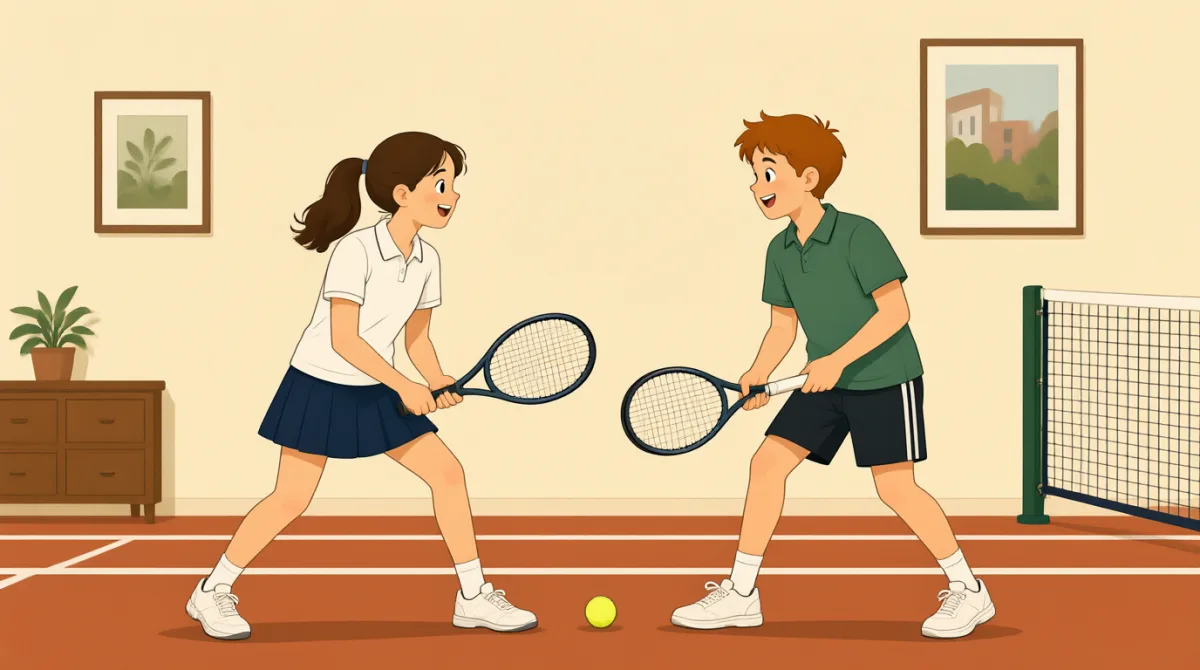

Ready to play, Jack?
Prêt à jouer, Jack ?

Yes! Let's start. You serve first.
Oui ! On commence. Tu sers en premier.
Okay. Here comes the ball!
D’accord. Attention, voilà la balle !
Nice shot! I'll hit it back.
Bien joué ! Je la renvoie.
Good! This is fun.
Super ! C’est amusant.
Yes, but I need a short break.
Oui, mais j’ai besoin d’une petite pause.
Sure. Let's drink some water.
Bien sûr. On va boire un peu d’eau.
Vocabulaire8
- Ready to playPrêt à jouer
This asks if someone is prepared to start playing. You can use it before a game or activity.
Cette expression sert à demander si quelqu’un est prêt à commencer à jouer. Tu peux l’utiliser avant un match ou une activité.
- Let's start.On commence.
This means it is time to begin. Use it when you are ready to do an activity together.
Cela signifie que c’est le moment de commencer. Utilise cette expression quand tu es prêt à faire une activité avec quelqu’un.
- serveservir
In tennis, to serve means to hit the ball to start a point. You can say, “You serve first” to let someone begin.
Au tennis, “serve” signifie frapper la balle pour commencer un point. Tu peux dire “You serve first” pour laisser quelqu’un commencer.
- Here comes the ball!Attention, voilà la balle !
This tells someone that the ball is coming toward them. You can use it during a game.
Cette expression prévient quelqu’un que la balle arrive vers lui. Tu peux l’utiliser pendant un match.
- Nice shot!Bien joué !
This is a friendly way to praise someone's good hit. You can use it in tennis or other sports.
C’est une façon amicale de féliciter quelqu’un pour un bon coup. Tu peux l’utiliser au tennis ou dans d’autres sports.
- hit it backla renvoyer
This means to hit the ball back toward the other player. You can use it when returning a ball.
Cela signifie frapper la balle pour la renvoyer vers l’autre joueur. Tu peux utiliser cette expression quand tu retournes une balle.
- short breakpetite pause
A short break is a little time to stop and rest. You can ask for one when you feel tired.
Une “short break”, c’est un petit moment pour s’arrêter et se reposer. Tu peux en demander une quand tu es fatigué.
- drink some waterboire un peu d’eau
This means to have water to drink. You can suggest it when someone needs a rest.
Cela signifie boire de l’eau. Tu peux le proposer quand quelqu’un a besoin de se reposer.
Phrases clés8
- 1
Ready to play, Jack?
Prêt à jouer, Jack ?
This is a simple way to ask if someone is ready to begin. You can change the name or activity, as in “Ready to eat?”
C’est une façon simple de demander si quelqu’un est prêt à commencer. Tu peux changer le prénom ou l’activité, comme dans “Ready to eat?” (Prêt à manger ?).
- 2
Let's start.
On commence.
Use this to suggest beginning an activity together. Replace “start” with another action, such as “Let's play.”
Utilise cette expression pour proposer de commencer une activité ensemble. Tu peux remplacer “start” par une autre action, comme dans “Let's play.” (On joue ?).
- 3
You serve first.
Tu sers en premier.
This tells someone to begin by serving in tennis. You can use “You go first” to let someone take the first turn in other situations.
Cette phrase indique à quelqu’un qu’il doit commencer en servant au tennis. Tu peux dire “You go first” pour laisser quelqu’un commencer dans d’autres situations.
- 4
Here comes the ball!
Attention, voilà la balle !
This warns someone that the ball is coming. You can use “Here comes…” to point out something that is moving toward someone.
Cette phrase prévient quelqu’un que la balle arrive. Tu peux utiliser “Here comes…” pour signaler quelque chose qui se dirige vers quelqu’un.
- 5
Nice shot!
Bien joué !
This is a short, friendly compliment for a good hit. You can also praise someone by saying “Nice job!”
C’est un compliment court et amical pour saluer un bon coup. Tu peux aussi féliciter quelqu’un en disant “Nice job!”.
- 6
I'll hit it back.
Je vais la renvoyer.
This tells the other player what you plan to do next. “I'll” is a useful way to talk about a quick decision or action.
Cette phrase indique à l’autre joueur ce que tu comptes faire ensuite. “I'll” est une façon pratique de parler d’une décision ou d’une action rapide.
- 7
I need a short break.
J’ai besoin d’une petite pause.
Use this to say that you need a little time to rest. You can change the length, as in “I need a longer break.”
Utilise cette phrase pour dire que tu as besoin d’un peu de temps pour te reposer. Tu peux préciser la durée, comme dans “I need a longer break.” (J’ai besoin d’une pause plus longue.).
- 8
Let's drink some water.
On va boire un peu d’eau.
This is a friendly suggestion to drink water together. You can use “Let's” to suggest simple activities, such as “Let's sit down.”
C’est une proposition amicale pour boire de l’eau ensemble. Tu peux utiliser “Let's” pour proposer des activités simples, comme dans “Let's sit down.” (Asseyons-nous.).