Asking How to Get There
Cómo llegar
Emma asks Jack how to get to the café and the park. Jack gives her simple directions and explains which bus to take.
Emma le pregunta a Jack cómo llegar a la cafetería y al parque. Jack le da indicaciones sencillas y le explica qué autobús tomar.
Diálogo6
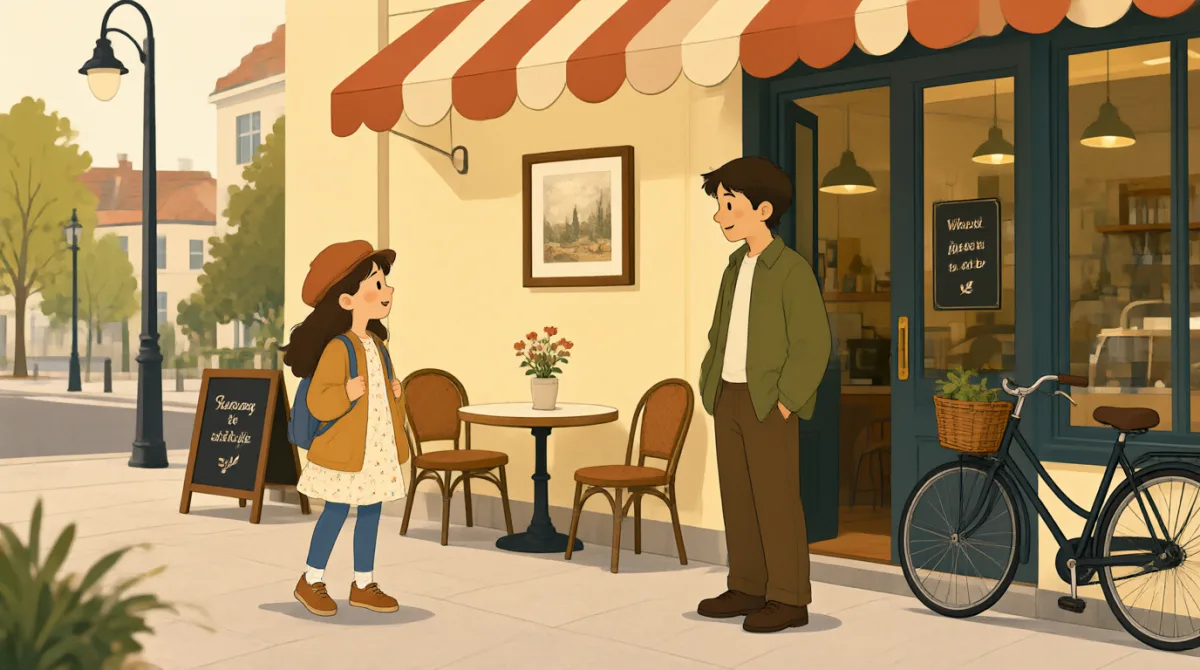

How do I get to the café and the park?
¿Cómo llego a la cafetería y al parque?

The café is near the museum. Go straight.
La cafetería está cerca del museo. Sigue recto.
And how do I get to the park?
¿Y cómo llego al parque?
Take the number two bus to the park.
Toma el autobús número dos para ir al parque.
Where is the bus stop?
¿Dónde está la parada de autobús?
It’s across the street, next to the bank.
Está al otro lado de la calle, al lado del banco.
Vocabulario8
- get tollegar a
This means to reach a place. Use “How do I get to...?” to ask for directions.
Significa alcanzar un lugar. Usa “How do I get to...?” para pedir indicaciones.
- nearcerca de
This means close to a place. You can say one place is near another.
Significa que está a poca distancia de un lugar. Puedes decir que un lugar está cerca de otro.
- museummuseo
A museum is a place where people see art or learn about history. In this dialogue, it helps Emma find the café.
Un museo es un lugar donde la gente ve obras de arte o aprende sobre historia. En este diálogo, ayuda a Emma a encontrar la cafetería.
- Go straight.Sigue recto.
This tells someone to keep going forward. It is a simple direction.
Le indica a alguien que siga avanzando. Es una indicación sencilla.
- Take the number two busToma el autobús número dos
This tells someone to ride bus number two. Use “Take the number [number] bus” to give bus directions.
Le indica a alguien que viaje en el autobús número dos. Usa “Take the number [number] bus” para dar indicaciones sobre qué autobús tomar.
- bus stopparada de autobús
A bus stop is a place where people wait for a bus. You can ask where it is.
Una parada de autobús es el lugar donde la gente espera el autobús. Puedes preguntar dónde está.
- across the streetal otro lado de la calle
This means on the other side of the street. It helps someone find a place.
Significa que está en el lado opuesto de la calle. Esta expresión ayuda a alguien a encontrar un lugar.
- next toal lado de
This means beside or very close to something. Use it to describe where a place is.
Significa junto a algo o muy cerca de ello. Úsalo para describir dónde está un lugar.
Frases clave7
- 1
How do I get to the café and the park?
¿Cómo llego a la cafetería y al parque?
Use this question to ask for directions to one or more places. You can replace “the café and the park” with the place you want to visit.
Usa esta pregunta para pedir indicaciones para llegar a uno o varios lugares. Puedes sustituir “the café and the park” por el lugar que quieras visitar.
- 2
The café is near the museum.
La cafetería está cerca del museo.
This sentence describes where a place is. Replace “the café” and “the museum” with other places.
Esta oración describe dónde está un lugar. Sustituye “the café” y “the museum” por otros lugares.
- 3
Go straight.
Sigue recto.
Use this short command to tell someone to continue forward. It is useful when giving simple directions.
Usa esta orden breve para decirle a alguien que siga avanzando. Es útil para dar indicaciones sencillas.
- 4
And how do I get to the park?
¿Y cómo llego al parque?
Use this to ask for directions to another place. Start with “And how do I get to...” when asking a follow-up question.
Usa esta pregunta para pedir indicaciones para llegar a otro lugar. Empieza con “And how do I get to...” cuando hagas una pregunta de seguimiento.
- 5
Take the number two bus to the park.
Toma el autobús número dos para ir al parque.
This sentence tells someone which bus to take and where to go. Replace “two” and “the park” with the bus number and destination.
Esta oración indica qué autobús tomar y adónde ir. Sustituye “two” y “the park” por el número del autobús y el destino.
- 6
Where is the bus stop?
¿Dónde está la parada de autobús?
Use this question to ask where you can catch a bus. You can replace “the bus stop” with another place.
Usa esta pregunta para preguntar dónde puedes tomar el autobús. Puedes sustituir “the bus stop” por otro lugar.
- 7
It’s across the street, next to the bank.
Está al otro lado de la calle, al lado del banco.
This sentence gives two clues about a location. Replace “across the street” and “next to the bank” with other location details.
Esta oración da dos pistas sobre la ubicación de un lugar. Sustituye “across the street” y “next to the bank” por otros detalles sobre la ubicación.