Leaving the House
Emma and Mia check the time and make sure they have everything. Then they leave the house together.
Dialogue6
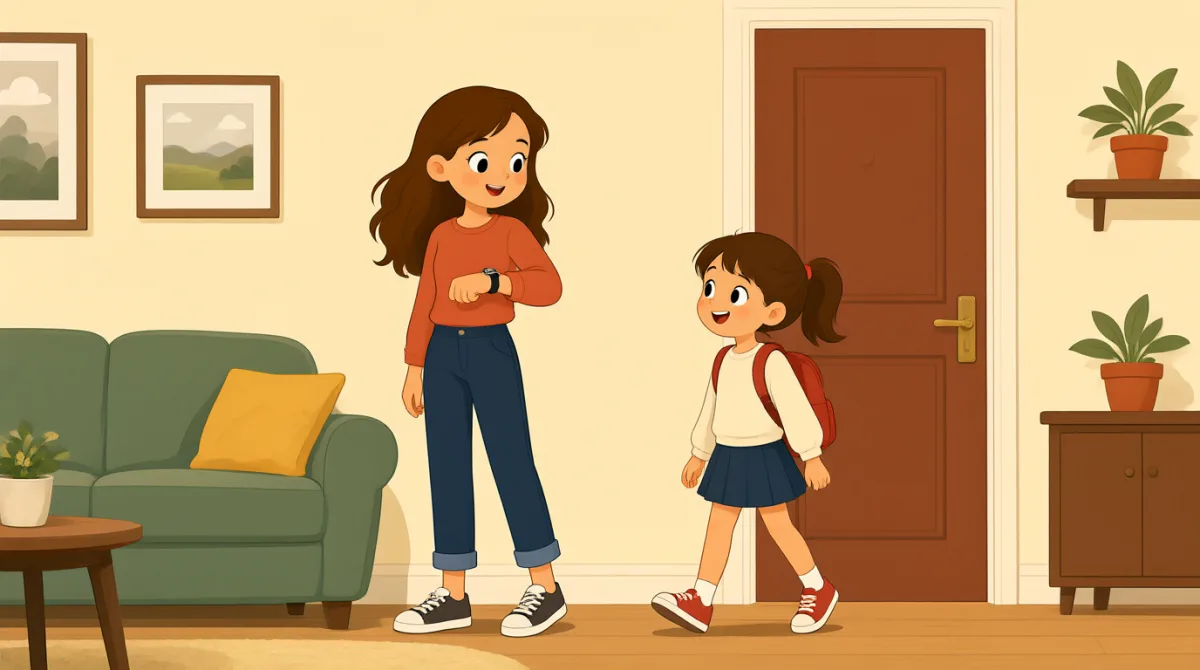

What time is it? Are we ready to go?

It’s six o’clock. Yes, I have my keys.
I have my phone and my bag.
Good. Do you have your jacket?
Yes, it’s by the door. Let’s go!
All right. I’m ready. Let’s leave.
Vocabulary6
- What time is it?
Use this question to ask for the current time.
- ready to go
This means prepared to leave. You can ask, “Are you ready to go?”
- keys
Keys open locks, such as the lock on your front door. You can say, “I have my keys” before leaving.
- by the door
This means next to the door. You can use it to say where something is.
- Let’s go!
Use this phrase to suggest that it is time to leave or start going somewhere.
- leave
Here, “leave” means to go out of the house. You can say, “I’m ready to leave.”
Key Sentences8
- 1
What time is it?
This is a simple way to ask for the time. You can use it at home, at school, or before meeting someone.
- 2
Are we ready to go?
Use this question to check if everyone is prepared to leave. You can change “we” to “you” when asking one person.
- 3
It’s six o’clock.
This is a simple way to tell someone the time. Replace “six” with another number to give a different time.
- 4
I have my keys.
Use this sentence to say that you have your keys with you. You can replace “keys” with another thing you need.
- 5
Do you have your jacket?
Use this question to check if someone has an item they need. Replace “jacket” with another item, such as “bag” or “phone.”
- 6
Yes, it’s by the door.
This sentence confirms that something is there and tells where it is. You can use “by the door” to describe the location of another item.
- 7
Let’s go!
Use this short phrase to suggest that it is time to leave. You can also say it when you are ready to start an activity.
- 8
I’m ready.
Use this sentence to say that you are prepared. You can add “to go,” as in “I’m ready to go.”