Mia’s Living Room
Salon Mii
Mia shows Emma the living room. They name the sofa, table, and other furniture and say where things are.
Mia pokazuje Emmie salon. Nazywają sofę, stół i inne meble oraz mówią, gdzie się znajdują.
Dialog7
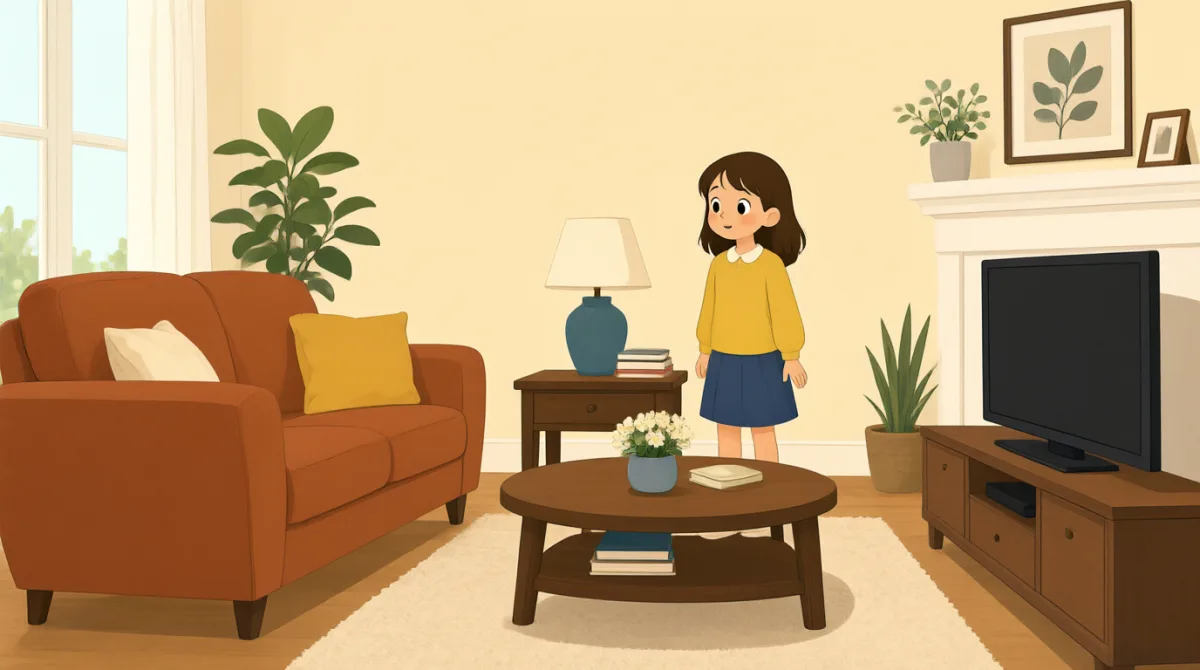

Come in, Emma. This is my living room.
Wejdź, Emma. To mój salon.

It’s nice! Where is the sofa?
Ale ładny! Gdzie jest sofa?
The sofa is by the window.
Sofa stoi przy oknie.
And where is the table?
A gdzie jest stół?
The small table is in front of the sofa.
Mały stolik stoi przed sofą.
I see a lamp. Is it on the table?
Widzę lampę. Czy stoi na stoliku?
Yes, it is. The TV is across from the sofa.
Tak. Telewizor stoi naprzeciwko sofy.
Słownictwo7
- living roomsalon
A living room is a room in a home where people sit and spend time together.
Salon to pomieszczenie w domu, w którym ludzie siedzą i spędzają razem czas.
- sofasofa
A sofa is a long, soft seat for two or more people.
Sofa to długie, miękkie siedzisko dla dwóch lub więcej osób.
- by the windowprzy oknie
This means next to the window.
To znaczy, że coś znajduje się obok okna.
- small tablemały stolik
A small table is a little piece of furniture with a flat top.
Mały stolik to niewielki mebel z płaskim blatem.
- in front ofprzed
This tells us that something is before another thing.
To określenie mówi, że coś znajduje się przed inną rzeczą.
- lamplampa
A lamp gives light in a room.
Lampa daje światło w pomieszczeniu.
- across fromnaprzeciwko
This means on the other side, facing something.
To znaczy, że coś znajduje się po drugiej stronie i jest zwrócone w stronę czegoś.
Kluczowe zdania8
- 1
This is my living room.
To mój salon.
Use this sentence to show someone a room in your home. You can change “living room” to another room name.
Użyj tego zdania, gdy pokazujesz komuś pomieszczenie w swoim domu. Możesz zastąpić “living room” nazwą innego pomieszczenia.
- 2
Where is the sofa?
Gdzie jest sofa?
Use this question to ask where something is. Change “the sofa” to another object.
Użyj tego pytania, żeby dowiedzieć się, gdzie coś się znajduje. Zastąp “the sofa” nazwą innego przedmiotu.
- 3
The sofa is by the window.
Sofa stoi przy oknie.
This sentence tells where the sofa is. Use “by the” plus a place to describe where something is.
To zdanie mówi, gdzie znajduje się sofa. Użyj “by the” i dodaj nazwę miejsca, żeby opisać położenie czegoś.
- 4
And where is the table?
A gdzie jest stół?
Use this question to ask about the location of another object. Start with “And” to continue asking questions.
Użyj tego pytania, żeby zapytać o położenie innego przedmiotu. Zacznij od “And”, aby zadać kolejne pytanie.
- 5
The small table is in front of the sofa.
Mały stolik stoi przed sofą.
This sentence describes where the table is. Use “in front of” to say that one thing is before another.
To zdanie opisuje, gdzie znajduje się stolik. Użyj “in front of”, żeby powiedzieć, że jedna rzecz jest przed drugą.
- 6
I see a lamp.
Widzę lampę.
Use this simple sentence to say that you notice something. Change “a lamp” to name another object.
Użyj tego prostego zdania, żeby powiedzieć, że coś zauważasz. Zastąp “a lamp” nazwą innego przedmiotu.
- 7
Is it on the table?
Czy stoi na stoliku?
Use this yes-or-no question to check if something is on a surface. Change “it” to the object you mean.
Użyj tego pytania, na które można odpowiedzieć tak lub nie, żeby sprawdzić, czy coś znajduje się na jakiejś powierzchni. Zastąp “it” nazwą przedmiotu, o który pytasz.
- 8
The TV is across from the sofa.
Telewizor stoi naprzeciwko sofy.
This sentence tells where the TV is. Use “across from” to describe something on the other side, facing an object.
To zdanie mówi, gdzie znajduje się telewizor. Użyj “across from”, żeby opisać coś, co znajduje się po drugiej stronie i jest zwrócone w stronę danego przedmiotu.