Mia’s Living Room
La sala de Mia
Mia shows Emma the living room. They name the sofa, table, and other furniture and say where things are.
Mia le muestra la sala a Emma. Nombran el sofá, la mesa y otros muebles, y dicen dónde están las cosas.
Diálogo7
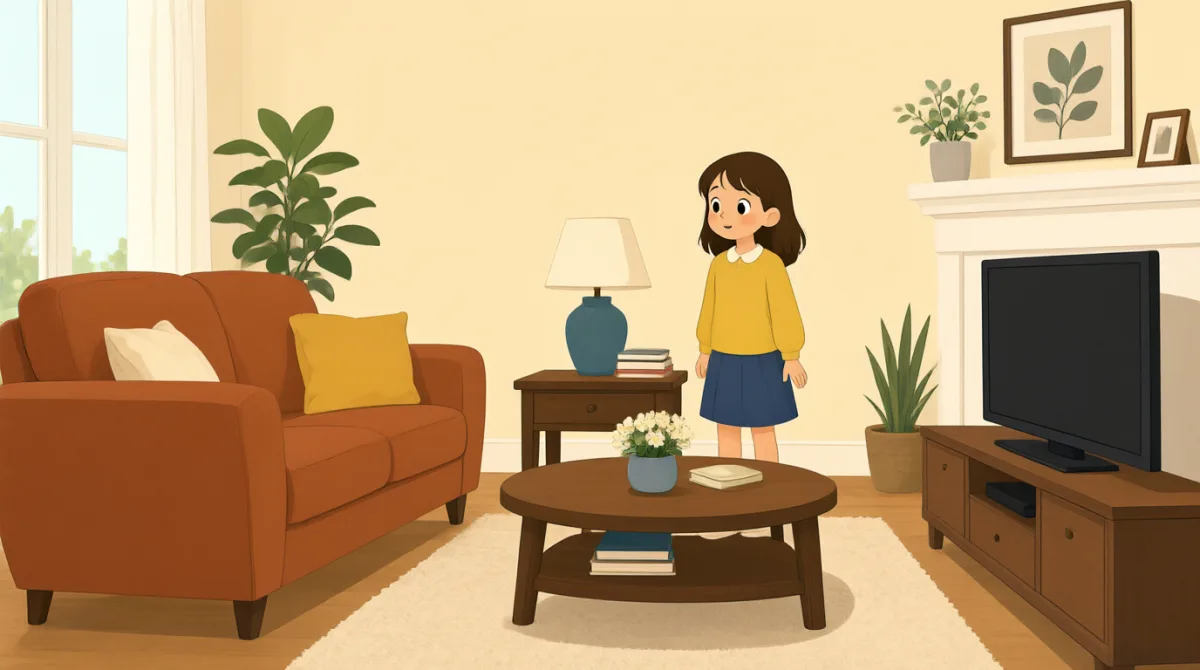

Come in, Emma. This is my living room.
Pasa, Emma. Esta es mi sala.

It’s nice! Where is the sofa?
¡Qué bonita! ¿Dónde está el sofá?
The sofa is by the window.
El sofá está junto a la ventana.
And where is the table?
¿Y dónde está la mesa?
The small table is in front of the sofa.
La mesita está delante del sofá.
I see a lamp. Is it on the table?
Veo una lámpara. ¿Está sobre la mesa?
Yes, it is. The TV is across from the sofa.
Sí. El televisor está enfrente del sofá.
Vocabulario7
- living roomsala
A living room is a room in a home where people sit and spend time together.
La sala es una habitación de la casa donde las personas se sientan y pasan tiempo juntas.
- sofasofá
A sofa is a long, soft seat for two or more people.
Un sofá es un asiento largo y acolchado para dos personas o más.
- by the windowjunto a la ventana
This means next to the window.
Significa que algo está al lado de la ventana.
- small tablemesita
A small table is a little piece of furniture with a flat top.
Una mesita es un mueble pequeño con una superficie plana.
- in front ofdelante de
This tells us that something is before another thing.
Esta expresión indica que algo está frente a otra cosa.
- lamplámpara
A lamp gives light in a room.
Una lámpara da luz a una habitación.
- across fromenfrente de
This means on the other side, facing something.
Significa que algo está al otro lado, de cara a otra cosa.
Frases clave8
- 1
This is my living room.
Esta es mi sala.
Use this sentence to show someone a room in your home. You can change “living room” to another room name.
Usa esta frase para mostrarle a alguien una habitación de tu casa. Puedes cambiar “living room” por el nombre de otra habitación.
- 2
Where is the sofa?
¿Dónde está el sofá?
Use this question to ask where something is. Change “the sofa” to another object.
Usa esta pregunta para preguntar dónde está algo. Cambia “the sofa” por otro objeto.
- 3
The sofa is by the window.
El sofá está junto a la ventana.
This sentence tells where the sofa is. Use “by the” plus a place to describe where something is.
Esta frase indica dónde está el sofá. Usa “by the” seguido de un lugar para describir dónde está algo.
- 4
And where is the table?
¿Y dónde está la mesa?
Use this question to ask about the location of another object. Start with “And” to continue asking questions.
Usa esta pregunta para preguntar dónde está otro objeto. Empieza con “And” para seguir haciendo preguntas.
- 5
The small table is in front of the sofa.
La mesita está delante del sofá.
This sentence describes where the table is. Use “in front of” to say that one thing is before another.
Esta frase describe dónde está la mesa. Usa “in front of” para decir que una cosa está delante de otra.
- 6
I see a lamp.
Veo una lámpara.
Use this simple sentence to say that you notice something. Change “a lamp” to name another object.
Usa esta frase sencilla para decir que notas algo. Cambia “a lamp” por el nombre de otro objeto.
- 7
Is it on the table?
¿Está sobre la mesa?
Use this yes-or-no question to check if something is on a surface. Change “it” to the object you mean.
Usa esta pregunta de sí o no para comprobar si algo está sobre una superficie. Cambia “it” por el objeto al que te refieres.
- 8
The TV is across from the sofa.
El televisor está enfrente del sofá.
This sentence tells where the TV is. Use “across from” to describe something on the other side, facing an object.
Esta frase indica dónde está el televisor. Usa “across from” para describir que algo está al otro lado y de cara a un objeto.