What’s in the Kitchen?
Co jest w kuchni?
Mia shows Emma the kitchen. They name a few common items and talk about where they are.
Mia pokazuje Emmie kuchnię. Nazywają kilka popularnych przedmiotów i rozmawiają o tym, gdzie się znajdują.
Dialog7
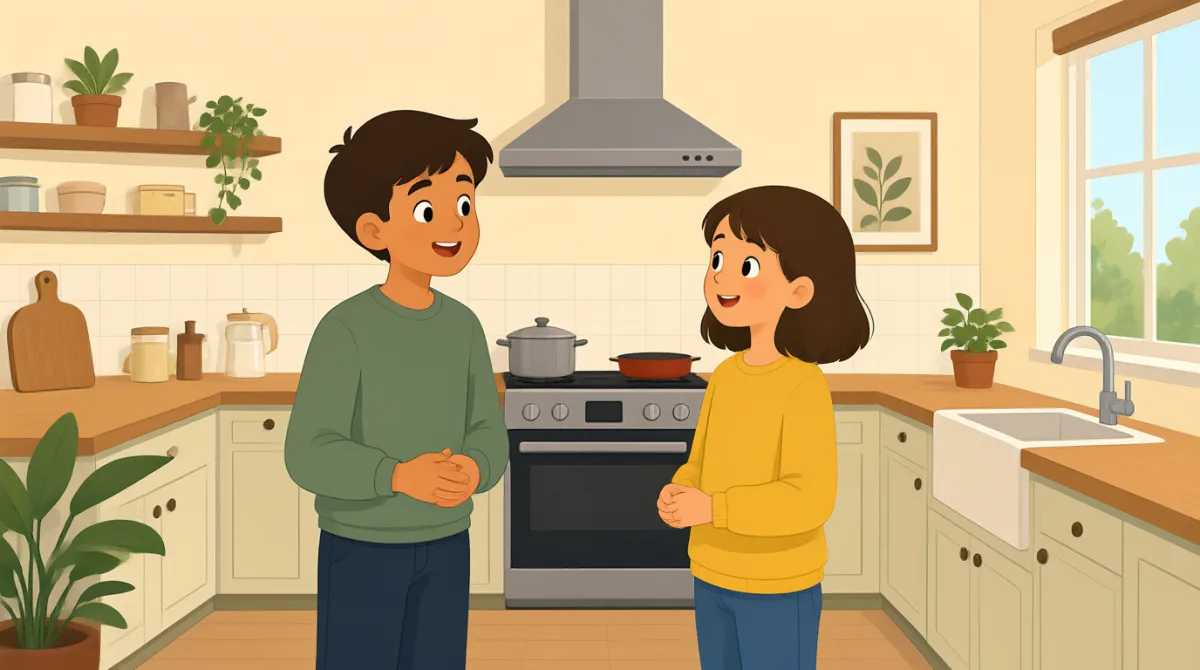

Come in, Emma. This is my kitchen.
Wejdź, Emma. To moja kuchnia.

It’s nice! What’s that on the table?
Jest ładna! Co to jest na stole?
It’s a bowl of fruit. The cups are here.
To miska z owocami. Kubki są tutaj.
Where are the plates?
Gdzie są talerze?
They’re in the cupboard, next to the sink.
Są w szafce, obok zlewu.
And where’s the fridge?
A gdzie jest lodówka?
It’s by the door. The milk is inside.
Jest przy drzwiach. Mleko jest w środku.
Słownictwo8
- Come inwejść; zapraszać do środka
This is a friendly way to invite someone inside. You can say it when a guest arrives.
To przyjazny sposób, by zaprosić kogoś do środka. Możesz tak powiedzieć, gdy przychodzi gość.
- kitchenkuchnia
A kitchen is a room where people prepare food. You can say, “This is my kitchen.”
Kuchnia to pomieszczenie, w którym przygotowuje się jedzenie. Możesz powiedzieć: „This is my kitchen.” (To moja kuchnia).
- a bowl of fruitmiska z owocami
This means fruit is inside a bowl. You can use “a bowl of” to talk about food in a bowl.
To znaczy, że owoce znajdują się w misce. „A bowl of” możesz użyć, mówiąc o jedzeniu w misce.
- cupskubki
Cups are things we use to drink from. You can say where they are, for example, “The cups are here.”
Kubków używamy do picia. Możesz powiedzieć, gdzie się znajdują, na przykład: „The cups are here.” (Kubki są tutaj).
- platestalerze
Plates are flat dishes for serving or eating food. You can ask, “Where are the plates?”
Talerze to płaskie naczynia, na których podaje się jedzenie lub z których się je. Możesz zapytać: „Where are the plates?” (Gdzie są talerze?).
- cupboardszafka
A cupboard is a place to keep dishes and other things. You can say, “The plates are in the cupboard.”
Szafka służy do przechowywania naczyń i innych rzeczy. Możesz powiedzieć: „The plates are in the cupboard.” (Talerze są w szafce).
- sinkzlew
A sink is a place where you wash dishes or your hands. “Next to the sink” tells you where something is.
Zlew to miejsce, w którym myje się naczynia lub ręce. „Next to the sink” mówi, gdzie coś się znajduje.
- fridgelodówka
A fridge keeps food and drinks cold. You can ask, “Where’s the fridge?”
Lodówka chłodzi jedzenie i napoje. Możesz zapytać: „Where’s the fridge?” (Gdzie jest lodówka?).
Kluczowe zdania8
- 1
Come in, Emma.
Wejdź, Emma.
Use this short phrase to invite someone inside. Say the person’s name at the end if you like.
Użyj tego krótkiego zwrotu, by zaprosić kogoś do środka. Jeśli chcesz, na końcu możesz dodać imię tej osoby.
- 2
This is my kitchen.
To moja kuchnia.
Use “This is my…” to show someone a room or an object that belongs to you.
Użyj „This is my…”, by pokazać komuś pomieszczenie lub przedmiot, który należy do ciebie.
- 3
What’s that on the table?
Co to jest na stole?
Use this question to ask about something you can see. Replace “that” with “this” for something close to you.
Użyj tego pytania, by zapytać o coś, co widzisz. Zastąp „that” słowem „this”, gdy chodzi o coś, co znajduje się blisko ciebie.
- 4
It’s a bowl of fruit.
To miska z owocami.
Use “It’s a…” to name something. You can change the words after “a” to describe another item.
Użyj „It’s a…”, by nazwać jakiś przedmiot. Możesz zmienić słowa po „a”, by opisać inną rzecz.
- 5
Where are the plates?
Gdzie są talerze?
Use “Where are the…?” to ask about more than one thing. For one thing, say “Where is the…?”
Użyj „Where are the…?”, by zapytać o więcej niż jedną rzecz. O jedną rzecz zapytaj: „Where is the…?”.
- 6
They’re in the cupboard, next to the sink.
Są w szafce, obok zlewu.
Use this sentence to say where things are. “In” and “next to” help describe a location.
Użyj tego zdania, by powiedzieć, gdzie coś się znajduje. „In” i „next to” pomagają opisać położenie.
- 7
It’s by the door.
Jest przy drzwiach.
Use “It’s by the…” to say something is close to a place or object. For example, “It’s by the window.”
Użyj „It’s by the…”, by powiedzieć, że coś znajduje się blisko jakiegoś miejsca lub przedmiotu. Na przykład: „It’s by the window.” (Jest przy oknie).
- 8
The milk is inside.
Mleko jest w środku.
Use this sentence to say that something is in a place already mentioned. You can replace “the milk” with another food or drink.
Użyj tego zdania, by powiedzieć, że coś znajduje się w miejscu, o którym była już mowa. Zamiast „the milk” możesz wstawić nazwę innego jedzenia lub napoju.