What’s in the Kitchen?
Qu’y a-t-il dans la cuisine ?
Mia shows Emma the kitchen. They name a few common items and talk about where they are.
Mia montre la cuisine à Emma. Elles nomment quelques objets courants et parlent de leur emplacement.
Dialogue7
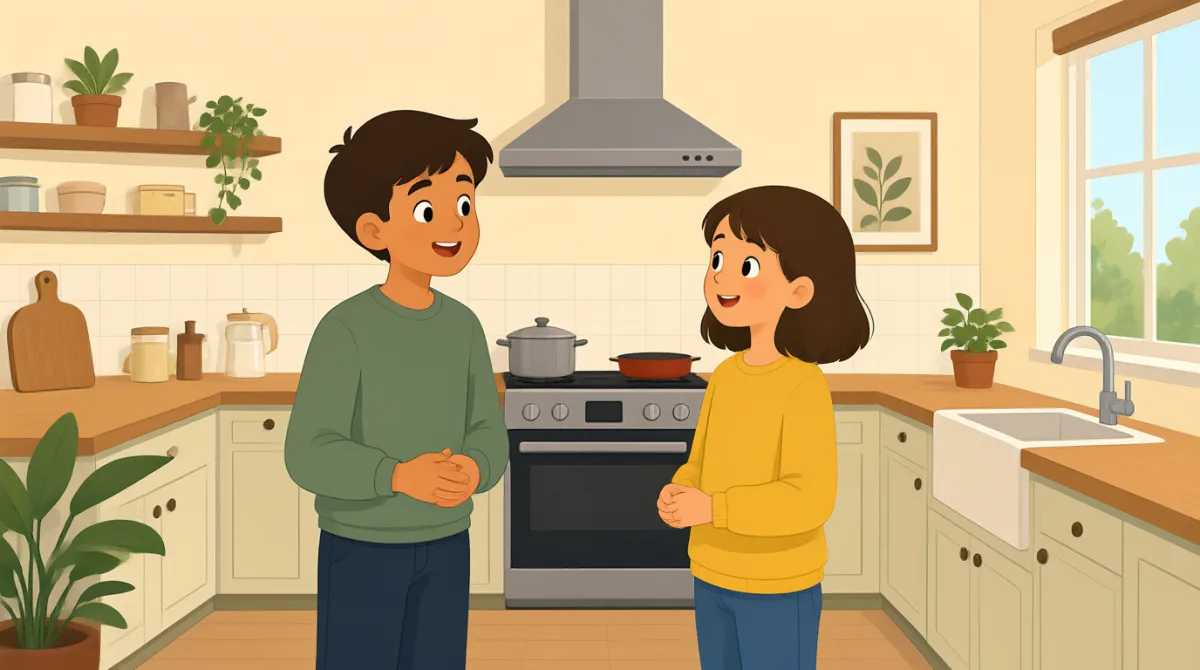

Come in, Emma. This is my kitchen.
Entre, Emma. Voici ma cuisine.

It’s nice! What’s that on the table?
C’est joli ! Qu’est-ce qu’il y a sur la table ?
It’s a bowl of fruit. The cups are here.
C’est un bol de fruits. Les tasses sont là.
Where are the plates?
Où sont les assiettes ?
They’re in the cupboard, next to the sink.
Elles sont dans le placard, à côté de l’évier.
And where’s the fridge?
Et le réfrigérateur, il est où ?
It’s by the door. The milk is inside.
Il est près de la porte. Le lait est dedans.
Vocabulaire8
- Come inEntre
This is a friendly way to invite someone inside. You can say it when a guest arrives.
C’est une façon amicale d’inviter quelqu’un à entrer. Tu peux le dire quand un invité arrive.
- kitchencuisine
A kitchen is a room where people prepare food. You can say, “This is my kitchen.”
Une cuisine est une pièce où l’on prépare à manger. Tu peux dire : “This is my kitchen.”
- a bowl of fruitun bol de fruits
This means fruit is inside a bowl. You can use “a bowl of” to talk about food in a bowl.
Cela signifie que des fruits se trouvent dans un bol. Tu peux utiliser “a bowl of” pour parler d’aliments dans un bol.
- cupstasses
Cups are things we use to drink from. You can say where they are, for example, “The cups are here.”
Les tasses sont des récipients dont on se sert pour boire. Tu peux dire où elles se trouvent, par exemple : “The cups are here.”
- platesassiettes
Plates are flat dishes for serving or eating food. You can ask, “Where are the plates?”
Les assiettes sont des plats plats qui servent à présenter ou à manger des aliments. Tu peux demander : “Where are the plates?”
- cupboardplacard
A cupboard is a place to keep dishes and other things. You can say, “The plates are in the cupboard.”
Un placard est un endroit où l’on range la vaisselle et d’autres choses. Tu peux dire : “The plates are in the cupboard.”
- sinkévier
A sink is a place where you wash dishes or your hands. “Next to the sink” tells you where something is.
Un évier est un endroit où l’on lave la vaisselle ou les mains. “Next to the sink” indique où se trouve quelque chose.
- fridgeréfrigérateur
A fridge keeps food and drinks cold. You can ask, “Where’s the fridge?”
Un réfrigérateur garde les aliments et les boissons au frais. Tu peux demander : “Where’s the fridge?”
Phrases clés8
- 1
Come in, Emma.
Entre, Emma.
Use this short phrase to invite someone inside. Say the person’s name at the end if you like.
Utilise cette courte expression pour inviter quelqu’un à entrer. Tu peux ajouter le prénom de la personne à la fin si tu veux.
- 2
This is my kitchen.
Voici ma cuisine.
Use “This is my…” to show someone a room or an object that belongs to you.
Utilise “This is my…” pour montrer à quelqu’un une pièce ou un objet qui t’appartient.
- 3
What’s that on the table?
Qu’est-ce qu’il y a sur la table ?
Use this question to ask about something you can see. Replace “that” with “this” for something close to you.
Utilise cette question pour demander ce qu’est quelque chose que tu vois. Remplace “that” par “this” pour parler de quelque chose qui est près de toi.
- 4
It’s a bowl of fruit.
C’est un bol de fruits.
Use “It’s a…” to name something. You can change the words after “a” to describe another item.
Utilise “It’s a…” pour nommer quelque chose. Tu peux changer les mots après “a” pour décrire un autre objet.
- 5
Where are the plates?
Où sont les assiettes ?
Use “Where are the…?” to ask about more than one thing. For one thing, say “Where is the…?”
Utilise “Where are the…?” pour demander où se trouvent plusieurs choses. Pour une seule chose, dis “Where is the…?”.
- 6
They’re in the cupboard, next to the sink.
Elles sont dans le placard, à côté de l’évier.
Use this sentence to say where things are. “In” and “next to” help describe a location.
Utilise cette phrase pour indiquer où se trouvent des choses. “In” et “next to” permettent de préciser leur emplacement.
- 7
It’s by the door.
Il est près de la porte.
Use “It’s by the…” to say something is close to a place or object. For example, “It’s by the window.”
Utilise “It’s by the…” pour dire que quelque chose se trouve près d’un endroit ou d’un objet. Par exemple : “It’s by the window.”
- 8
The milk is inside.
Le lait est dedans.
Use this sentence to say that something is in a place already mentioned. You can replace “the milk” with another food or drink.
Utilise cette phrase pour dire que quelque chose se trouve dans un endroit déjà mentionné. Tu peux remplacer “the milk” par un autre aliment ou une autre boisson.