Greeting the Teacher
Saludar a la maestra
At the classroom door, Mia and her child greet the teacher. The teacher welcomes the child to school.
En la puerta del aula, Mia y su hija saludan a la maestra. La maestra le da la bienvenida a la niña.
Diálogo7
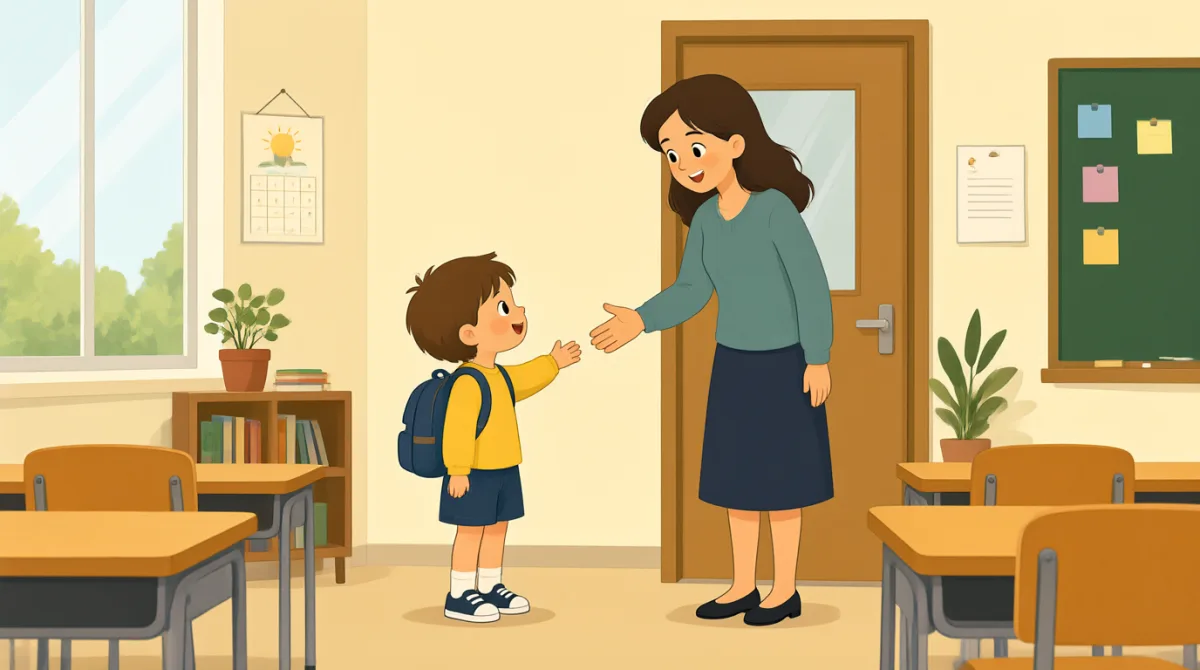

Good morning, Grace. This is Emma.
Buenos días, Grace. Ella es Emma.

Good morning, Emma. Welcome to school!
Buenos días, Emma. ¡Bienvenida a la escuela!

Good morning, Grace. I have my bag.
Buenos días, Grace. Tengo mi mochila.
Great! Are you ready for class?
¡Muy bien! ¿Estás lista para la clase?
Yes, I am. I am ready.
Sí. Estoy lista.
Have a good day, Emma. Listen to Grace.
Que tengas un buen día, Emma. Hazle caso a Grace.
We will have a lovely day. Come on in!
¡Pasaremos un día estupendo! ¡Adelante!
Vocabulario6
- Good morningBuenos días
A polite greeting used in the morning. You can say it when you meet a teacher or another person.
Es un saludo cortés que se usa por la mañana. Puedes decirlo cuando te encuentres con una maestra u otra persona.
- Welcome to schoolBienvenida a la escuela
This tells someone you are happy they are at school. You can say it to a new student.
Así le haces saber a alguien que te alegra que esté en la escuela. Puedes decírselo a una alumna nueva.
- my bagmi mochila
This means the bag belongs to me. You can use “my” before something that belongs to you.
Significa que la mochila me pertenece. Puedes usar “my” antes de algo que te pertenece.
- ready for classlista para la clase
This means prepared to start a lesson. You can ask, “Are you ready for class?”
Significa que estás preparada para empezar una clase. Puedes preguntar: “Are you ready for class?”
- Have a good dayQue tengas un buen día
This is a friendly way to wish someone a nice day. You can say it when you say goodbye.
Es una forma amable de desearle a alguien que tenga un buen día. Puedes decirlo al despedirte.
- Come on inPasa
This is a friendly way to invite someone to enter. You can use it at a classroom or home.
Es una forma amable de invitar a alguien a entrar. Puedes decirlo en un aula o en casa.
Frases clave8
- 1
Good morning, Grace.
Buenos días, Grace.
Use this simple greeting when you meet someone in the morning. Change “Grace” to the person’s name.
Usa este saludo sencillo cuando te encuentres con alguien por la mañana. Cambia “Grace” por el nombre de esa persona.
- 2
This is Emma.
Ella es Emma.
Use this sentence to introduce someone. Say “This is” and then the person’s name.
Usa esta frase para presentar a alguien. Di “This is” y luego el nombre de la persona.
- 3
Welcome to school!
¡Bienvenida a la escuela!
Use this to greet a student and make them feel welcome. You can change “school” to another place.
Usa esta frase para saludar a una alumna y hacer que se sienta bienvenida. Puedes cambiar “school” por otro lugar.
- 4
I have my bag.
Tengo mi mochila.
Use this sentence to say that you have something with you. Change “my bag” to another item, like “my book.”
Usa esta frase para decir que llevas algo contigo. Cambia “my bag” por otro objeto, como “my book.”
- 5
Are you ready for class?
¿Estás lista para la clase?
Use this question to ask if someone is prepared for a lesson. You can change “class” to another activity.
Usa esta pregunta para saber si alguien está preparado para una clase. Puedes cambiar “class” por otra actividad.
- 6
Yes, I am.
Sí, lo estoy.
Use this short answer to say yes to a question like “Are you ready?”
Usa esta respuesta breve para contestar que sí a una pregunta como “Are you ready?”
- 7
Have a good day, Emma.
Que tengas un buen día, Emma.
Use this friendly phrase when saying goodbye. Add the person’s name at the end.
Usa esta frase amable al despedirte. Añade al final el nombre de la persona.
- 8
Come on in!
¡Pasa!
Use this phrase to invite someone to come inside. It sounds friendly and welcoming.
Usa esta frase para invitar a alguien a entrar. Suena amable y acogedora.