Saying Where You Are
Decir dónde estás
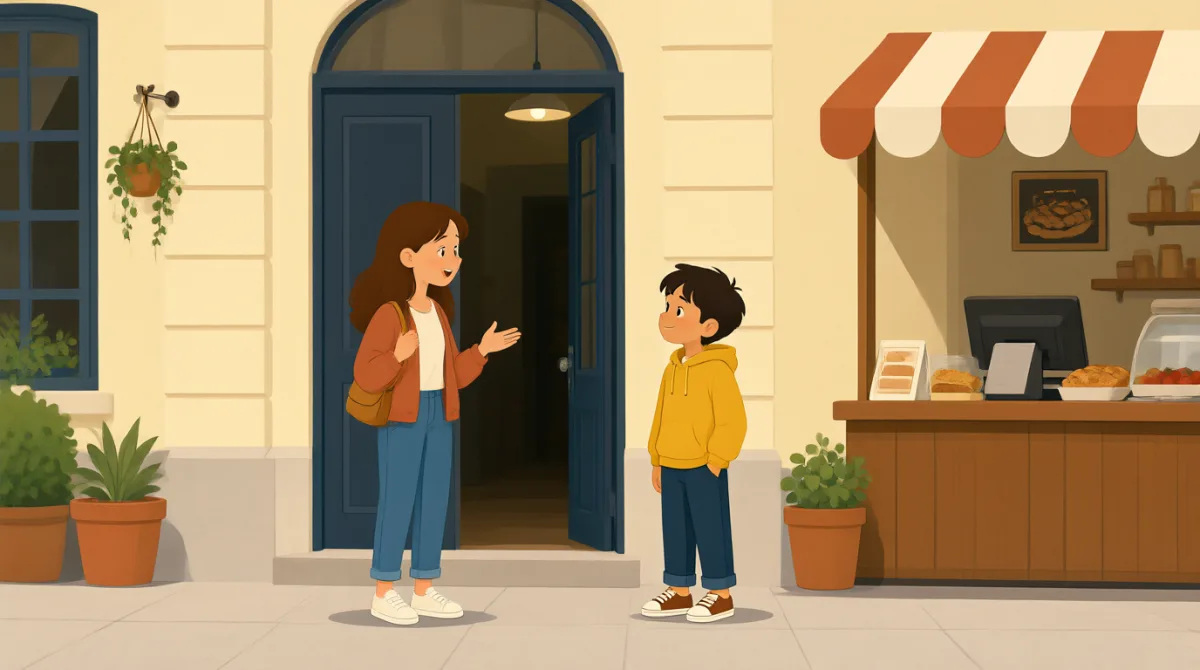
Emma and Leo tell each other where they are. Emma is near the main entrance, and Leo is by a food stand.
Emma y Leo se dicen dónde están. Emma está cerca de la entrada principal y Leo está junto a un puesto de comida.
Diálogo7

Leo, where are you?
Leo, ¿dónde estás?

I’m by the food stand. Where are you?
Estoy junto al puesto de comida. ¿Y tú?
I’m near the main entrance.
Estoy cerca de la entrada principal.
Do you see the big doors?
¿Ves las puertas grandes?
Yes, I’m standing near them.
Sí, estoy parada cerca de ellas.
I see the food stand now.
Ya veo el puesto de comida.
Great. I’m near the main entrance.
Genial. Estoy cerca de la entrada principal.
Vocabulario6
- Where are you?¿Dónde estás?
Ask someone where they are. You can use this question when you cannot see a friend.
Pregunta dónde está alguien. Puedes usar esta pregunta cuando no encuentres a un amigo.
- by the food standjunto al puesto de comida
This means next to or very close to the food stand. Use “by” to say where you are.
Significa al lado del puesto de comida o muy cerca de él. Usa “by” para decir dónde estás.
- near the main entrancecerca de la entrada principal
This means close to the main entrance. Use “near” to describe a place that is not far away.
Significa que estás cerca de la entrada principal. Usa “near” para describir un lugar que no está lejos.
- Do you see the big doors?¿Ves las puertas grandes?
Ask if someone can see the big doors. You can use “Do you see…?” to help a friend find something.
Pregunta si alguien puede ver las puertas grandes. Puedes usar “Do you see…?” para ayudar a un amigo a encontrar algo.
- standing near themde pie cerca de ellas
This means standing close to the doors. “Them” refers to the big doors.
Significa estar de pie cerca de las puertas. “Them” se refiere a las puertas grandes.
- food standpuesto de comida
A small place that sells food. You can use this phrase to tell someone where to meet you.
Un lugar pequeño donde venden comida. Puedes usar esta expresión para decirle a alguien dónde encontrarte.
Frases clave8
- 1
Leo, where are you?
Leo, ¿dónde estás?
Use this question to find out where someone is. Say the person’s name first to get their attention.
Usa esta pregunta para averiguar dónde está alguien. Di primero el nombre de la persona para llamar su atención.
- 2
I’m by the food stand.
Estoy junto al puesto de comida.
Use this sentence to tell someone your location. Replace “the food stand” with a nearby place.
Usa esta frase para decirle a alguien dónde estás. Puedes cambiar “the food stand” por un lugar cercano.
- 3
Where are you?
¿Dónde estás?
This is a simple way to ask someone’s location. You can use it when you are trying to meet up.
Esta es una forma sencilla de preguntar dónde está alguien. Puedes usarla cuando intentas encontrarte con esa persona.
- 4
I’m near the main entrance.
Estoy cerca de la entrada principal.
Use this sentence to say you are close to the main entrance. Replace “the main entrance” with another place.
Usa esta frase para decir que estás cerca de la entrada principal. Puedes cambiar “the main entrance” por otro lugar.
- 5
Do you see the big doors?
¿Ves las puertas grandes?
Use this question to check whether someone can see a nearby landmark. Replace “the big doors” with something easy to spot.
Usa esta pregunta para comprobar si alguien puede ver un punto de referencia cercano. Puedes cambiar “the big doors” por algo fácil de reconocer.
- 6
Yes, I’m standing near them.
Sí, estoy parada cerca de ellas.
Use this sentence to confirm where you are. “Them” refers to the big doors.
Usa esta frase para confirmar dónde estás. “Them” se refiere a las puertas grandes.
- 7
I see the food stand now.
Ya veo el puesto de comida.
Use this sentence when you can finally see a place or person you were looking for. You can change “the food stand” to another thing.
Usa esta frase cuando por fin puedes ver el lugar o a la persona que estabas buscando. Puedes cambiar “the food stand” por otra cosa.
- 8
Great.
¡Genial!
Use this short word to show that you are pleased or that something is going well.
Usa esta palabra corta para mostrar que te alegras o que algo va bien.