Asking a Friend How They Feel
Eine Freundin fragen, wie sie sich fühlt
Mia meets Emma and asks how she feels today. Emma answers, and then asks Mia the same question.
Mia trifft Emma und fragt sie, wie sie sich heute fühlt. Emma antwortet und stellt Mia dann dieselbe Frage.
Dialog6
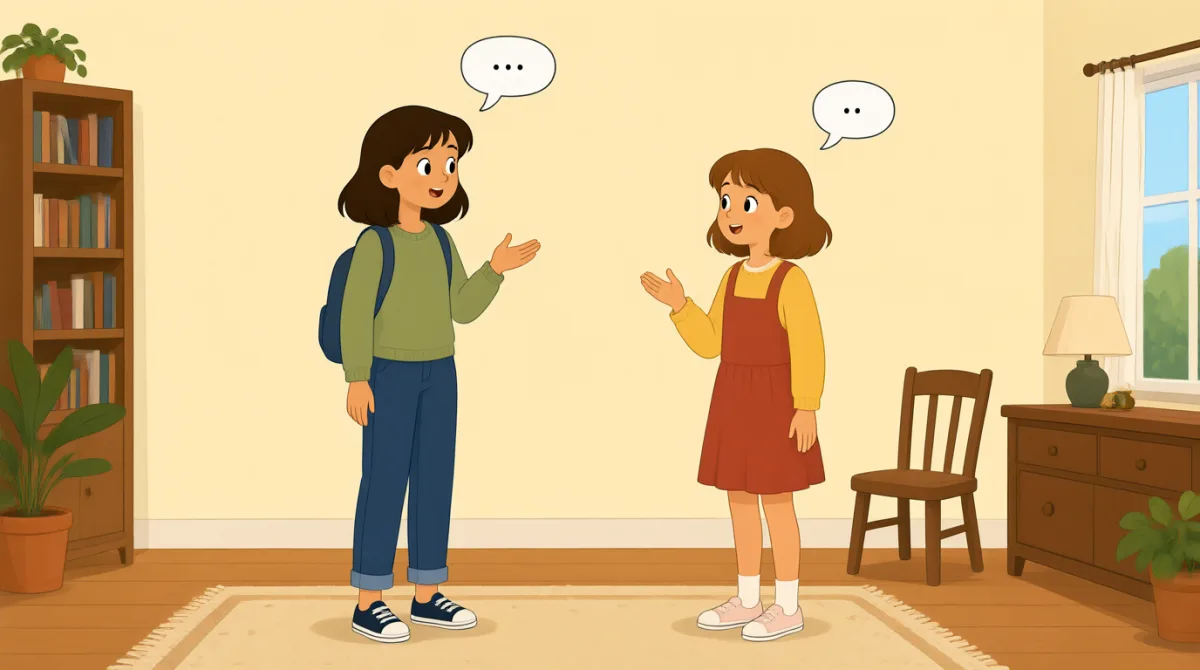

Hi, Emma! How do you feel today?
Hi, Emma! Wie fühlst du dich heute?

I feel happy today. How about you?
Ich bin heute glücklich. Und du?
I feel good, thanks. The sun is out.
Mir geht’s gut, danke. Die Sonne scheint.
Yes, it is a beautiful day!
Ja, es ist ein wunderschöner Tag!
Do you feel tired at all?
Bist du vielleicht müde?
No, I feel great. I slept well.
Nein, mir geht’s super. Ich habe gut geschlafen.
Wortschatz8
- How do you feel today?How do you feel today? — Wie fühlst du dich heute?
Ask someone about their feelings today. You can use this question to start a friendly conversation.
Mit „How do you feel today?“ fragst du jemanden, wie er sich heute fühlt. Diese Frage eignet sich gut als Einstieg in ein freundliches Gespräch.
- I feel happy today.I feel happy today. — Ich bin heute glücklich.
Say that you are happy now. You can change “happy” to another feeling word.
Mit „I feel happy today.“ sagst du, dass du gerade glücklich bist. Du kannst „happy“ durch ein anderes Wort für ein Gefühl ersetzen.
- How about you?How about you? — Und du?
Ask the other person the same question. Use it to invite them to share their answer.
Mit „How about you?“ stellst du der anderen Person dieselbe Frage. So kannst du sie dazu einladen, auch ihre Antwort zu teilen.
- I feel good, thanks.I feel good, thanks. — Mir geht’s gut, danke.
Give a short, friendly answer about how you feel. You can use it when someone asks how you are.
Mit „I feel good, thanks.“ gibst du eine kurze, freundliche Antwort darauf, wie du dich fühlst. Du kannst den Satz verwenden, wenn dich jemand fragt, wie es dir geht.
- The sun is out.The sun is out. — Die Sonne scheint.
Say that the sun is shining. This is a simple way to talk about the weather.
Mit „The sun is out.“ sagst du, dass die Sonne scheint. So kannst du auf einfache Weise über das Wetter sprechen.
- a beautiful daya beautiful day — ein wunderschöner Tag
A day with nice weather can be called a beautiful day. You can also use this phrase to make friendly conversation.
Bei schönem Wetter kannst du von „a beautiful day“ sprechen. Die Wendung eignet sich auch gut für ein freundliches Gespräch.
- Do you feel tired at all?Do you feel tired at all? — Bist du vielleicht müde?
Ask if someone feels tired. “At all” makes the question sound gentle.
Mit „Do you feel tired at all?“ fragst du, ob jemand müde ist. „At all“ lässt die Frage sanfter klingen.
- I slept well.I slept well. — Ich habe gut geschlafen.
Say that you had good sleep. You can use this phrase to explain why you feel good.
Mit „I slept well.“ sagst du, dass du gut geschlafen hast. Du kannst den Satz verwenden, um zu erklären, warum du dich gut fühlst.
Wichtige Sätze8
- 1
Hi, Emma! How do you feel today?
Hi, Emma! Wie fühlst du dich heute?
Use this friendly greeting to ask about someone’s feelings. Change the name to speak to another person.
Mit „Hi, Emma! How do you feel today?“ begrüßt du jemanden freundlich und fragst, wie er sich fühlt. Ersetze den Namen, wenn du eine andere Person ansprichst.
- 2
I feel happy today.
Ich bin heute glücklich.
Use this sentence to tell someone how you feel. Replace “happy” with another feeling, such as “tired” or “good.”
Mit „I feel happy today.“ sagst du jemandem, wie du dich fühlst. Ersetze „happy“ durch ein anderes Gefühl, zum Beispiel „tired“ oder „good“.
- 3
How about you?
Und du?
Use this short question to ask the other person the same thing. It works in many everyday conversations.
Mit „How about you?“ fragst du die andere Person kurz dasselbe. Die Frage passt zu vielen Alltagssituationen.
- 4
I feel good, thanks.
Mir geht’s gut, danke.
This is a polite, simple answer when someone asks how you feel. You can change “good” to another feeling.
„I feel good, thanks.“ ist eine höfliche, einfache Antwort, wenn jemand fragt, wie du dich fühlst. Du kannst „good“ durch ein anderes Gefühl ersetzen.
- 5
The sun is out.
Die Sonne scheint.
Use this sentence to talk about sunny weather. It can help you make small talk.
Mit „The sun is out.“ sprichst du über sonniges Wetter. Der Satz eignet sich gut für ein wenig Small Talk.
- 6
Yes, it is a beautiful day!
Ja, es ist ein wunderschöner Tag!
Use this sentence to agree and say something positive about the weather. You can use it on a nice day.
Mit „Yes, it is a beautiful day!“ stimmst du zu und sagst etwas Positives über das Wetter. Der Satz passt zu einem schönen Tag.
- 7
Do you feel tired at all?
Bist du vielleicht müde?
Use this question to check if someone is tired. You can replace “tired” with another feeling word.
Mit „Do you feel tired at all?“ fragst du, ob jemand müde ist. Du kannst „tired“ durch ein anderes Wort für ein Gefühl ersetzen.
- 8
No, I feel great.
Nein, mir geht’s super.
Use this sentence to say that you are not tired and feel very good. Replace “great” with another feeling word.
Mit „No, I feel great.“ sagst du, dass du nicht müde bist und dich sehr gut fühlst. Ersetze „great“ durch ein anderes Wort für ein Gefühl.