Getting the Glasses
Przygotowanie szklanek
Leo asks where the glasses are. Grace tells him to put one by each plate.
Leo pyta, gdzie są szklanki. Grace mówi mu, żeby postawił po jednej przy każdym talerzu.
Dialog7
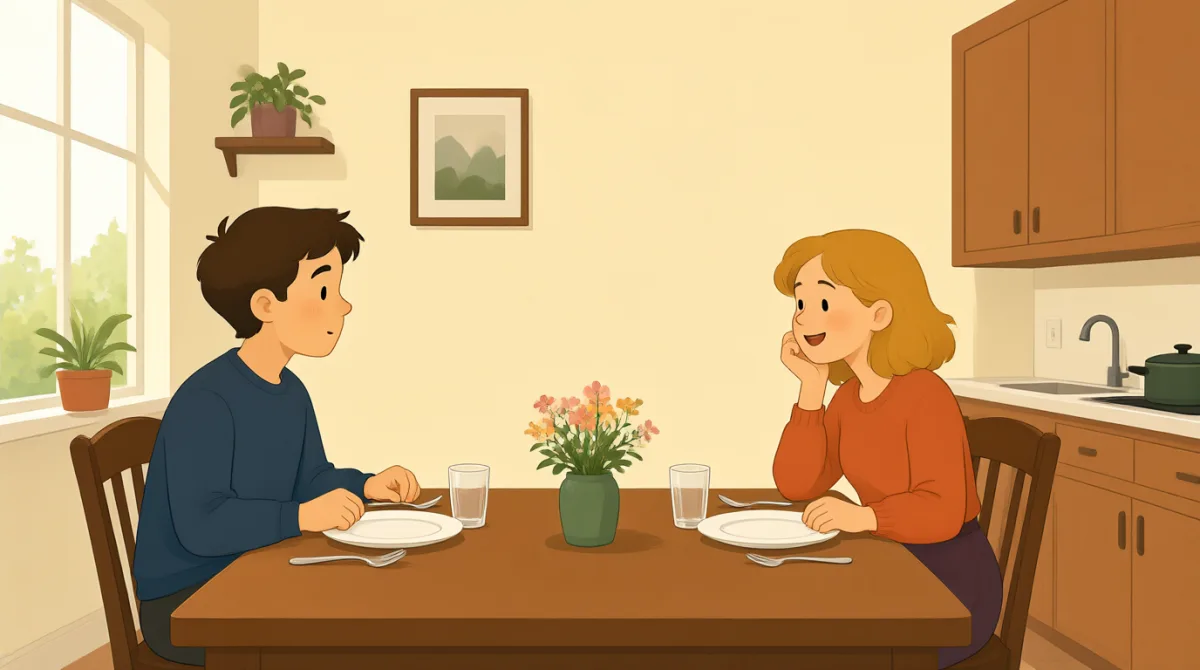

Grace, where are the glasses?
Grace, gdzie są szklanki?

They are in the kitchen cabinet.
W szafce kuchennej.
How many glasses do we need?
Ile szklanek potrzebujemy?
We need six. Put one by each plate.
Potrzebujemy sześciu. Postaw po jednej przy każdym talerzu.
Okay. I’ll get them now.
Dobra. Zaraz je przyniosę.
Thank you. Please be careful.
Dziękuję. Uważaj, proszę.
They’re here. One by each plate.
Już są. Po jednej przy każdym talerzu.
Słownictwo6
- glassesszklanki
Glasses are cups we drink from. Here, they are for dinner.
Szklanki to naczynia, z których pijemy. Tutaj są potrzebne do kolacji.
- kitchen cabinetszafka kuchenna
A kitchen cabinet is a place to keep things in a kitchen. The glasses are inside it.
Szafka kuchenna to miejsce, w którym przechowuje się różne rzeczy w kuchni. Szklanki są w środku.
- How many glasses do we need?Ile szklanek potrzebujemy?
Use this question to ask how many glasses or other things are needed.
Tego pytania używamy, żeby zapytać, ile szklanek lub innych rzeczy jest potrzebnych.
- sixsześć
Six is the number of glasses they need.
Sześć to liczba potrzebnych im szklanek.
- by each plateprzy każdym talerzu
This means next to every plate. Use “by each” to say where to put one thing for every person.
To znaczy: obok każdego talerza. Wyrażenia „by each” używamy, żeby powiedzieć, gdzie umieścić po jednej rzeczy dla każdej osoby.
- be carefuluważać
This means to do something slowly and safely. You can say it when someone is carrying breakable things.
To znaczy robić coś ostrożnie i bezpiecznie. Możesz tak powiedzieć, gdy ktoś niesie coś, co łatwo stłuc.
Kluczowe zdania8
- 1
Grace, where are the glasses?
Grace, gdzie są szklanki?
Use this to ask where something is. Replace “the glasses” with another thing, such as “the plates.”
Tego pytania używamy, żeby zapytać, gdzie coś jest. Zamiast „the glasses” możesz powiedzieć coś innego, na przykład „the plates”.
- 2
They are in the kitchen cabinet.
Są w szafce kuchennej.
This gives the location of something. Use “It is in…” for one thing and “They are in…” for more than one.
Tak podajemy, gdzie coś się znajduje. Przy jednej rzeczy użyj „It is in…”, a przy większej liczbie „They are in…”.
- 3
How many glasses do we need?
Ile szklanek potrzebujemy?
Use this to ask how many items are needed. Replace “glasses” with another plural noun, such as “plates.”
Tego pytania używamy, żeby zapytać, ile rzeczy jest potrzebnych. Zamiast „glasses” możesz użyć innego rzeczownika w liczbie mnogiej, na przykład „plates”.
- 4
We need six.
Potrzebujemy sześciu.
This is a simple way to say how many things are needed. Replace “six” with another number.
To prosty sposób, żeby powiedzieć, ile rzeczy jest potrzebnych. Zamiast „six” możesz użyć innej liczby.
- 5
Put one by each plate.
Postaw po jednej przy każdym talerzu.
Use this to give a simple instruction about where to put something. Replace “plate” with another item or place.
Tego zdania używamy, żeby prosto powiedzieć, gdzie coś postawić. Zamiast „plate” możesz podać inny przedmiot lub miejsce.
- 6
Okay. I’ll get them now.
Dobra. Zaraz je przyniosę.
Use this to agree to do something right away. Replace “get them” with another task, such as “wash them.”
Tego zdania używamy, żeby zgodzić się na zrobienie czegoś od razu. Zamiast „get them” możesz podać inne zadanie, na przykład „wash them”.
- 7
Thank you.
Dziękuję.
This is a polite way to show that you are grateful. You can use it after someone helps you.
To uprzejmy sposób, żeby okazać wdzięczność. Możesz tak powiedzieć, gdy ktoś ci pomaga.
- 8
Please be careful.
Uważaj, proszę.
Use this polite reminder when someone needs to do something safely. You can say it when they are carrying glasses or other breakable things.
Tego uprzejmego przypomnienia używamy, gdy ktoś musi coś zrobić bezpiecznie. Możesz tak powiedzieć, gdy ktoś niesie szklanki lub inne rzeczy, które łatwo stłuc.