Choosing Clothes
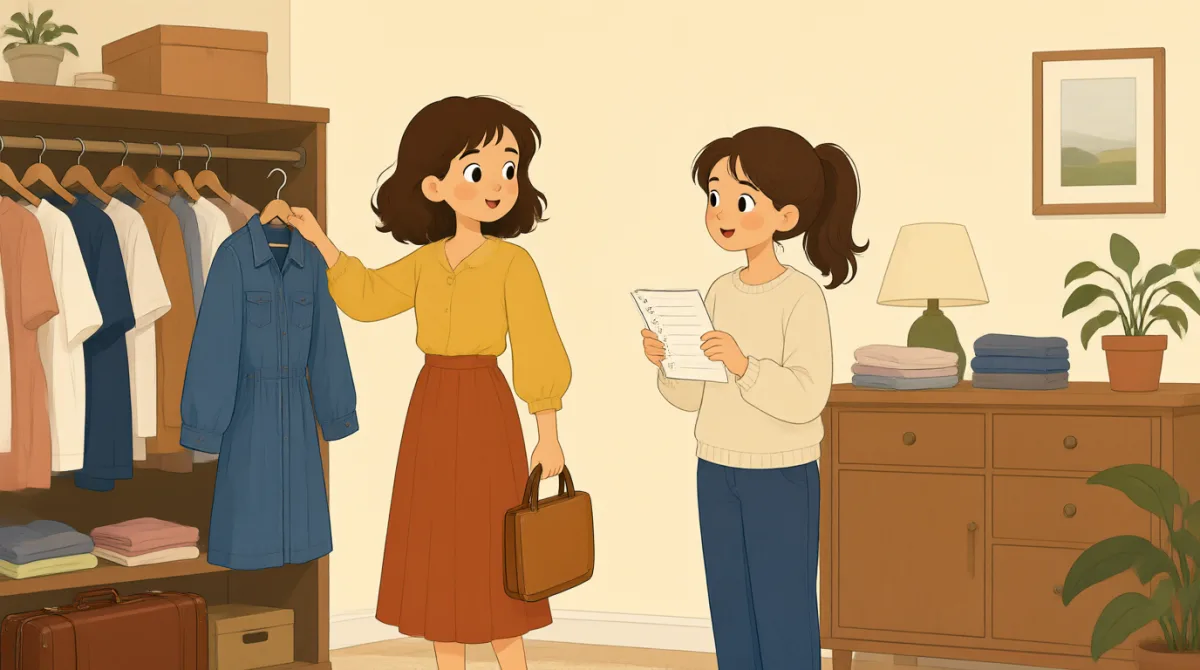
Emma chooses clothes for the trip, and Mia helps her decide what to pack. They keep the list simple.
Dialogue8

What clothes should I pack for our trip?

How many days are we going?
Just two days. I want to pack light.
Take two shirts and one pair of pants.
Should I bring a warm jacket?
Yes, bring one. It may be cold.
Okay. I'll pack one jacket and two shirts.
Good. Keep it simple.
Vocabulary7
- pack light
To pack only a few things. You can use this phrase when you do not want to bring many clothes.
- two days
This means a period of two days. Use it to say how long a trip or visit lasts.
- two shirts
This means two pieces of clothing worn on the upper body. Use it to say how many shirts you want to bring.
- one pair of pants
This means one item of clothing that covers your legs. Use “a pair of pants” when talking about pants.
- warm jacket
A warm jacket helps you stay comfortable in cold weather. You can use “warm” to describe clothes for cold days.
- bring one
This means to take one item with you. Use it when the item is clear from the conversation.
- keep it simple
This means to avoid making something complicated. You can use it when you want to choose or do only what is needed.
Key Sentences8
- 1
What clothes should I pack for our trip?
Use this to ask what clothes you need to bring. You can change “clothes” to another item, such as “shoes” or “food.”
- 2
How many days are we going?
Use this to ask how long a trip will last. You can also ask, “How many days are you staying?”
- 3
Just two days.
This is a short way to say the trip lasts only two days. Replace “two” with another number to give a different length.
- 4
I want to pack light.
Use this to say you want to bring only a few things. You can use it when packing for a trip.
- 5
Take two shirts and one pair of pants.
Use this to suggest what someone should bring. Change the clothes and numbers to give different suggestions.
- 6
Should I bring a warm jacket?
Use this to ask if you need to take something with you. Replace “a warm jacket” with another item.
- 7
It may be cold.
Use this to say that the weather could be cold. You can replace “cold” with another weather word, such as “rainy.”
- 8
Keep it simple.
Use this to encourage someone not to make a choice or plan complicated. It is also useful when you want to focus on only the basics.