A Dinner-Table Disagreement
食卓での意見の食い違い
At a family dinner, Emma argues that AI could eliminate many jobs, while David says the greater change may be to the tasks people do. Their disagreement stays lively but respectful.
家族で夕食を囲むなか、エマはAIによって多くの仕事がなくなる可能性があると主張し、デイビッドは人々が仕事で担う業務のほうが大きく変わるかもしれないと言う。二人の意見は食い違うが、議論は活発でありながらも敬意を保っている。
会話12
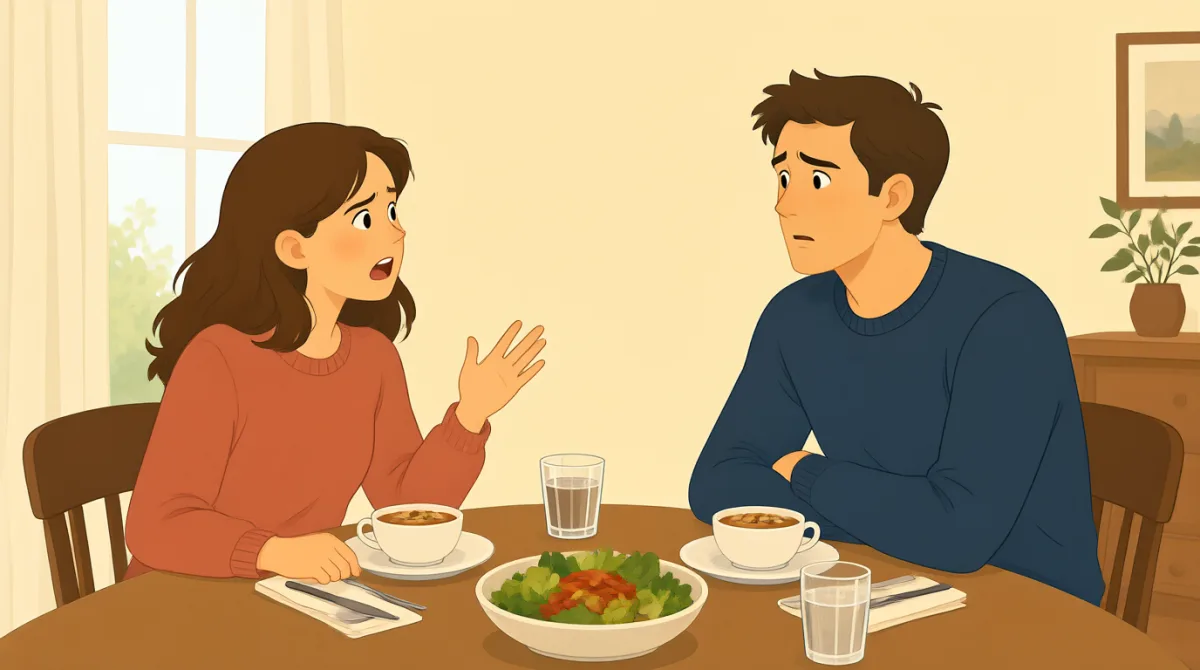

I keep hearing that AI will make entire professions disappear. If a system can draft reports, answer customers, and analyze data in seconds, why would a company keep so many people on payroll?
AIのせいで職業そのものがなくなるって、よく聞くんだ。報告書を作ったり、顧客に対応したり、データを分析したりできるシステムが数秒でできるなら、会社はどうしてそんなに多くの人を雇い続けるんだろう?

Because doing those tasks quickly isn’t the same as doing a whole job well. A job involves judgment, accountability, and dealing with situations the system wasn’t trained to handle.
そうした作業を速くこなせることと、仕事全体をうまくやることは別だからだよ。仕事には判断力や責任を負うこと、それにシステムが対応できるよう学習していない状況への対処も必要なんだ。
That distinction sounds reassuring, but companies don’t need AI to do a job perfectly. If it handles most of the workload, they may need fewer employees, even if a person still checks the final result.
その違いを聞くと安心できそうだけど、会社はAIに仕事を完璧にこなしてもらう必要はないんだよ。仕事の大部分をAIが担えば、最後の結果を人が確認するとしても、従業員を減らせるかもしれない。
Fair point. Efficiency can reduce staffing, and I wouldn’t dismiss that risk. But technology can also make certain services cheaper, which may increase demand and create work that wasn’t viable before.
それはもっともだね。効率が上がれば人員を減らせるし、そのリスクを軽く見るつもりはないよ。でも、テクノロジーでサービスが安くなれば、需要が増えて、以前は成り立たなかった仕事が生まれることもある。
Sometimes, yes. But that assumes new demand arrives quickly enough and benefits the people whose jobs have vanished. A growing industry doesn’t automatically hire the workers displaced from another one.
そういうこともあるね。でもそれは、新しい需要が十分早く生まれて、仕事を失った人たちにも恩恵があるという前提だよね。成長産業が、別の産業で職を失った人たちを自動的に雇うわけじゃない。
You’re right that the transition can be painful and uneven. Still, predictions about mass unemployment often treat every task exposed to automation as though the entire occupation were about to disappear.
移行がつらくて、影響にも偏りが出るっていうのはそのとおりだよ。それでも、大量失業の予測では、自動化の影響を受ける業務があると、職業全体がなくなろうとしているかのように扱われることが多いんだ。
I’m not saying every exposed job vanishes overnight. I’m saying that when enough core tasks are automated, the role can shrink until there are only a few positions left—and those remaining workers may face much higher expectations.
自動化の影響を受ける仕事が全部、一夜にしてなくなると言ってるわけじゃないよ。仕事の中核となる業務が十分に自動化されれば、その役割が縮小して、残るポストはほんのわずかになることがある。しかも、残った人にはずっと高い水準が求められるかもしれない。
That’s a stronger argument than simply saying, ‘AI takes all the jobs.’ I’d add that new roles often emerge, but there’s no guarantee they’ll appear in the same places or be accessible to the same workers.
「AIが仕事を全部奪う」と言うより、ずっと説得力のある主張だね。新しい役割が生まれることは多いけど、同じ場所に生まれるとも、同じ人たちが就けるとも限らない、という点も付け加えたいな。
Exactly. So when people say technology creates more jobs than it destroys, I want to know: for whom, where, and over what period? The total number can hide serious losses for particular communities.
まさにそう。だから、テクノロジーは失われる仕事より多くの仕事を生み出すと言われたら、誰にとって?どこで?どのくらいの期間で?って知りたくなるんだ。全体の数だけでは、特定の地域社会が受ける深刻な打撃が見えなくなることがあるから。
That’s a fair challenge. I still think the biggest change may be what people do within their jobs, rather than the disappearance of work altogether. But that doesn’t make displacement imaginary—or painless.
それはもっともな指摘だね。仕事そのものがなくなるというより、仕事の中で人がすることが大きく変わるんじゃないかと、僕は今でも思ってる。でもだからといって、職を失うことが現実じゃないとか、つらくないとかいうわけじゃないよ。
And I can accept that many jobs will change rather than disappear. I just don’t want that possibility to become an excuse for ignoring people who may lose their livelihoods along the way.
仕事の多くはなくなるんじゃなくて、変わるんだということは私も受け入れられるよ。ただ、その可能性を理由にして、その過程で生活の糧を失うかもしれない人たちを見過ごしてほしくないんだ。
Nor should we. Perhaps the honest answer is that AI won’t produce one uniform future: some jobs will vanish, many will be reshaped, and the consequences will depend partly on how deliberately we manage the transition.
もちろん、見過ごすべきじゃないよ。正直な答えは、AIが一様な未来をもたらすわけではない、ということかもしれないね。なくなる仕事もあれば、大きく形を変える仕事もたくさんある。そしてその結果は、移行をどれだけ計画的に進めるかにも左右されるんだ。
語彙8
- on payroll雇用している
Employed by a company and receiving a regular salary. Here, Emma questions why a company would continue employing many people if AI can do their tasks.
会社に雇われ、定期的に給料を受け取っているという意味です。ここではエマが、AIに業務を任せられるなら、会社がなぜ多くの人を雇い続けるのかと疑問を投げかけています。
- accountability責任
Responsibility for decisions and their results. In this discussion, it is one part of a job that may require human judgment.
判断を下し、その結果に責任を持つことです。この話では、人間の判断が求められる仕事の要素の一つとして使われています。
- wouldn’t dismiss that riskそのリスクを軽く見るつもりはない
A measured way to say you take a possible danger seriously. Use it to acknowledge a concern without claiming it is certain to happen.
起こると決まったわけではないものの、あり得る危険を真剣に受け止めていると伝える、控えめな表現です。相手の懸念を認めつつ、確実に起こるとまでは言いたくないときに使えます。
- viable before以前は成り立たなかった
Practical or financially possible in the past. Here, cheaper services could create work in areas that were previously too costly to operate.
以前は実用的でなかった、または採算が取れなかったという意味です。ここでは、サービスの費用が下がることで、以前は運営コストが高すぎた分野にも仕事が生まれる可能性を示しています。
- displaced from another one別の産業で職を失った
Moved out of one job or industry, often because the work has changed or disappeared. The phrase highlights that new jobs may not go to the people who lost their old ones.
仕事の内容が変わったり、なくなったりしたために、ある仕事や産業から離れることです。新しい仕事が生まれても、以前の仕事を失った人がその仕事に就けるとは限らない、という点を強調する表現です。
- uneven偏りがある
Not happening equally or affecting everyone in the same way. It describes transitions in which some workers or communities face greater disruption than others.
すべての人に同じように起こるのではなく、影響の受け方に差があることです。一部の労働者や地域社会が、ほかより大きな変化に直面するような移行を表します。
- core tasks中核となる業務
The most important duties that make up a job. If enough of these are automated, the role itself may shrink.
仕事を成り立たせている、最も重要な業務です。こうした業務が十分に自動化されると、仕事そのものが縮小する可能性があります。
- livelihoods生活の糧
The work or income people depend on to support themselves. It is often used when discussing the serious personal consequences of job loss.
人々が生活を支えるために頼りにしている仕事や収入のことです。失業が個人にもたらす深刻な影響について話すときによく使われます。
重要な文8
- 1
A job involves judgment, accountability, and dealing with situations the system wasn’t trained to handle.
仕事には判断力や責任を負うこと、それにシステムが対応できるよう学習していない状況への対処も必要なんだ。
This sentence explains why completing individual tasks is not the same as doing an entire job. Reuse the structure “A [role] involves...” to describe the skills and responsibilities a role requires.
この文は、個々の作業をこなすことと、仕事全体を担うことは違うと説明しています。「A [role] involves...」という形を使うと、ある役割に必要なスキルや責任を説明できます。
- 2
Efficiency can reduce staffing, and I wouldn’t dismiss that risk.
効率が上がれば人員を減らせるし、そのリスクを軽く見るつもりはないよ。
This is a concise way to concede a valid concern while keeping a measured tone. Reuse “I wouldn’t dismiss that risk” when you want to show that a possibility deserves serious consideration.
もっともな懸念を認めながら、冷静な口調を保つ簡潔な言い方です。可能性を真剣に検討する価値があると伝えたいときは、「I wouldn’t dismiss that risk」を使ってみましょう。
- 3
A growing industry doesn’t automatically hire the workers displaced from another one.
成長産業が、別の産業で職を失った人たちを自動的に雇うわけじゃない。
This sentence distinguishes overall job growth from who actually gets hired. Use “doesn’t automatically...” to challenge an assumption without overstating your case.
この文は、仕事の数が全体として増えることと、実際に誰が雇われるかを区別しています。「doesn’t automatically...」を使えば、言い過ぎずに相手の前提に異議を唱えられます。
- 4
You’re right that the transition can be painful and uneven.
移行がつらくて、影響にも偏りが出るっていうのはそのとおりだよ。
This acknowledges another person’s point while adding a qualification. The pattern “You’re right that...” is useful for respectful disagreement and nuanced discussion.
相手の意見を認めたうえで、条件や補足を加える表現です。「You’re right that...」は、敬意を保ちながら意見を述べたいときや、微妙な問題について話し合うときに役立ちます。
- 5
I’d add that new roles often emerge, but there’s no guarantee they’ll appear in the same places or be accessible to the same workers.
新しい役割が生まれることは多いけど、同じ場所に生まれるとも、同じ人たちが就けるとも限らない、という点も付け加えたいな。
This sentence balances a general trend with practical limits. Reuse “I’d add that...” to extend someone’s argument, and “there’s no guarantee...” to express uncertainty.
この文は、一般的な傾向を示しつつ、現実的な制約にも触れています。「I’d add that...」は相手の主張に考えを付け加えるとき、「there’s no guarantee...」は不確実性を表すときに使えます。
- 6
The total number can hide serious losses for particular communities.
全体の数だけでは、特定の地域社会が受ける深刻な打撃が見えなくなることがある。
This shows how broad statistics can obscure unequal effects. Use the structure “X can hide...” to explain why a headline figure may not tell the whole story.
幅広い統計では、影響の偏りが見えにくくなることを示しています。「X can hide...」という形を使うと、見出しになるような数字だけでは全体像がわからない理由を説明できます。
- 7
I still think the biggest change may be what people do within their jobs, rather than the disappearance of work altogether.
仕事そのものがなくなるというより、仕事の中で人がすることが大きく変わるんじゃないかと、僕は今でも思ってる。
This presents a qualified position and contrasts two possible outcomes. Reuse “I still think...” to maintain your view while acknowledging that the issue is complex.
この文は、断定を避けた立場を示し、二つの可能性を対比しています。「I still think...」を使えば、問題が複雑だと認めつつ、自分の考えを保っていることを表せます。
- 8
Perhaps the honest answer is that AI won’t produce one uniform future: some jobs will vanish, many will be reshaped, and the consequences will depend partly on how deliberately we manage the transition.
正直な答えは、AIが一様な未来をもたらすわけではない、ということかもしれないね。なくなる仕事もあれば、大きく形を変える仕事もたくさんある。そしてその結果は、移行をどれだけ計画的に進めるかにも左右されるんだ。
This is a useful way to conclude a debate with a nuanced summary rather than a simple yes-or-no claim. The colon introduces examples, while “will depend partly on...” identifies a factor that can influence the outcome.
これは、単純に「はい」「いいえ」で結論づけず、複雑な内容をまとめて議論を締めくくるのに便利な表現です。コロンの後には具体例が続き、「will depend partly on...」は結果に影響を与える要因を示します。