Asking for a Fork
Pedir un tenedor
Emma's noodles arrive, but she needs a fork. She asks Jack for one, and he brings it to her.
Llegan los fideos de Emma, pero necesita un tenedor. Se lo pide a Jack y él se lo trae.
Diálogo6
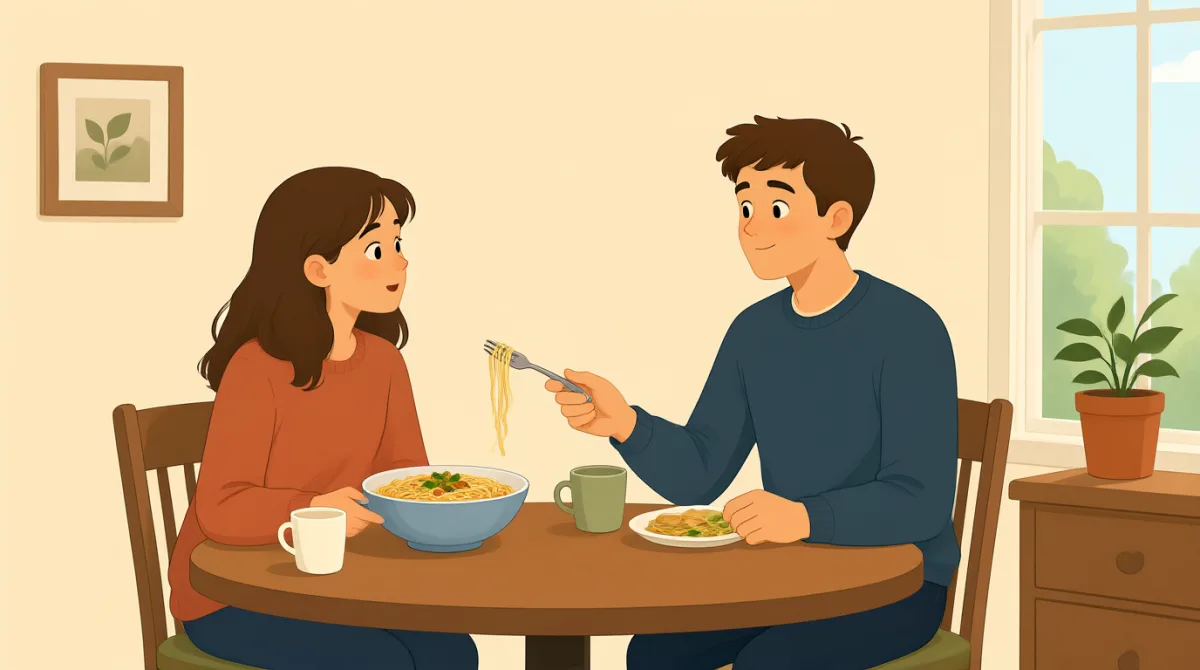

Here are your noodles, Emma.
Aquí tienes tus fideos, Emma.

Thanks. Can I have a fork, please?
Gracias. ¿Me puedes traer un tenedor, por favor?
Sure. Do you need chopsticks too?
Claro. ¿También necesitas palillos?
No, just a fork, please.
No, solo un tenedor, por favor.
Here you are. Enjoy your noodles!
Aquí tienes. ¡Que disfrutes los fideos!
Thank you! They look great.
¡Gracias! Tienen muy buena pinta.
Vocabulario8
- Here are your noodles.Aquí tienes tus fideos.
Jack uses this phrase to give Emma her food. You can use it when handing something to someone.
Jack usa esta frase para servirle la comida a Emma. También puedes decirla cuando le das algo a alguien.
- Can I have a fork, please?¿Me puedes traer un tenedor, por favor?
Use this polite question to ask for something. Replace “a fork” with the item you need.
Usa esta pregunta cortés para pedir algo. Sustituye “a fork” por el objeto que necesitas.
- Sure.Claro.
This is a friendly way to say yes. You can use it when you agree to help someone.
Es una forma amable de decir que sí. Puedes usarla cuando aceptas ayudar a alguien.
- chopstickspalillos
Chopsticks are sticks used to eat food. You can ask for them when you eat noodles.
Los palillos son utensilios que se usan para comer. Puedes pedirlos cuando comes fideos.
- just a forksolo un tenedor
This means Emma wants only a fork. Use “just” to say you need only one thing.
Esto significa que Emma solo quiere un tenedor. Usa “just” para decir que solo necesitas una cosa.
- Here you are.Aquí tienes.
Say this when you give something to someone. It is a polite way to hand over an item.
Di esto cuando le das algo a alguien. Es una forma cortés de entregarle un objeto.
- Enjoy your noodles!¡Que disfrutes los fideos!
This is a friendly way to wish someone a good meal. You can say “Enjoy your…” before the name of a food.
Es una forma amable de desearle a alguien que disfrute de la comida. Puedes decir “Enjoy your…” antes del nombre de un alimento.
- They look great.Tienen muy buena pinta.
Emma says the noodles look very good. Use “It looks great” or “They look great” to share a positive opinion.
Emma dice que los fideos se ven muy bien. Usa “It looks great” o “They look great” para expresar una opinión positiva.
Frases clave8
- 1
Here are your noodles, Emma.
Aquí tienes tus fideos, Emma.
Use this sentence to tell someone their food is ready. You can replace “noodles” with another food.
Usa esta frase para decirle a alguien que su comida está lista. Puedes sustituir “noodles” por otro alimento.
- 2
Can I have a fork, please?
¿Me puedes traer un tenedor, por favor?
This is a polite way to ask for something. You can reuse “Can I have a…?” to ask for an item at a shop or restaurant.
Esta es una forma cortés de pedir algo. Puedes usar “Can I have a…?” para pedir un objeto en una tienda o un restaurante.
- 3
Do you need chopsticks too?
¿También necesitas palillos?
Use this question to ask if someone wants one more thing. Replace “chopsticks” with another item.
Usa esta pregunta para saber si alguien quiere algo más. Sustituye “chopsticks” por otro objeto.
- 4
No, just a fork, please.
No, solo un tenedor, por favor.
This is a polite way to say you want only one thing. Use “No, just a…” to make your choice clear.
Esta es una forma cortés de decir que solo quieres una cosa. Usa “No, just a…” para dejar clara tu elección.
- 5
Here you are.
Aquí tienes.
Say this when you give something to someone. You can use it when handing over an item.
Di esto cuando le das algo a alguien. Puedes usarlo al entregarle un objeto.
- 6
Enjoy your noodles!
¡Que disfrutes los fideos!
Use this friendly phrase to wish someone a good meal. Replace “noodles” with the food they are eating.
Usa esta expresión amable para desearle a alguien que disfrute de la comida. Sustituye “noodles” por el alimento que está comiendo.
- 7
Thank you!
¡Gracias!
Use this short phrase to show that you are grateful. It is useful whenever someone helps you or gives you something.
Usa esta frase breve para demostrar que estás agradecido. Es útil cuando alguien te ayuda o te da algo.
- 8
They look great.
Tienen muy buena pinta.
Use this sentence to say that something looks very good. You can change “They” to “It” when talking about one thing.
Usa esta frase para decir que algo se ve muy bien. Puedes cambiar “They” por “It” cuando hablas de una sola cosa.