Asking What Page We’re On
Preguntar en qué página estamos
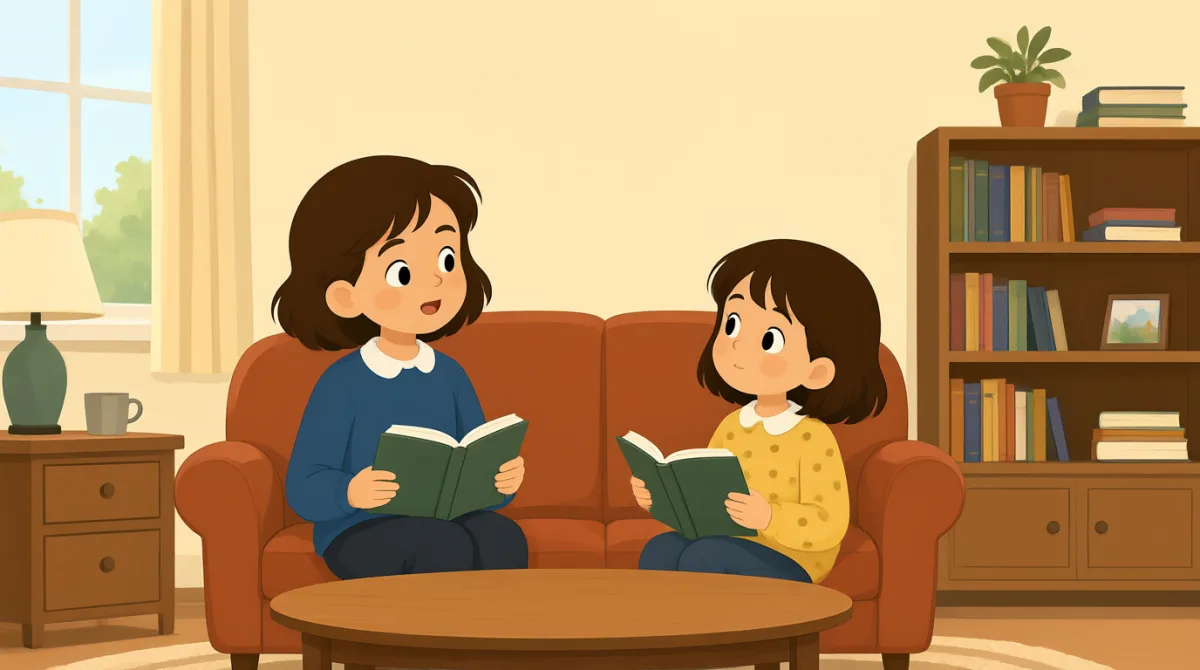
Emma asks Mia what page the class is on. Mia tells her the page number.
Emma le pregunta a Mia en qué página va la clase. Mia le dice el número de página.
Diálogo6

Mia, what page are we on?
Mia, ¿en qué página vamos?

We’re on page twelve.
Vamos por la página doce.
Thanks. I was on page ten.
Gracias. Yo iba por la página diez.
No problem. Please turn to page twelve.
No hay problema. Ve a la página doce, por favor.
Okay. I’m there now.
Vale. Ya estoy ahí.
Great. Let’s read the next part.
Genial. Leamos la siguiente parte.
Vocabulario8
- what pagequé página
Use this to ask for the number of a page. For example, “What page are we on?”
Usa esta expresión para preguntar el número de una página. Por ejemplo, “What page are we on?” (¿En qué página vamos?).
- We’re on page twelve.We’re on page twelve.
This tells someone the page the class is reading. You can change “twelve” to another page number.
Esto le dice a alguien qué página está leyendo la clase. Puedes cambiar “twelve” por otro número de página.
- Thanks.Thanks.
Use this short word to thank someone. It is common in everyday conversation.
Usa esta palabra breve para darle las gracias a alguien. Es muy común en las conversaciones cotidianas.
- I was on page ten.I was on page ten.
This says which page you were reading before. Change “ten” to the page number you were on.
Esto indica qué página estabas leyendo antes. Cambia “ten” por el número de la página en la que estabas.
- No problem.No problem.
Use this friendly phrase to say that helping was easy or okay.
Usa esta expresión amigable para decir que ayudar no te ha costado nada o que no hay problema.
- Please turn to page twelve.Please turn to page twelve.
Use this polite instruction to tell someone to open the book to a page. Change “twelve” to another page number.
Usa esta instrucción amable para decirle a alguien que abra el libro por una página. Cambia “twelve” por otro número de página.
- I’m there now.I’m there now.
This tells someone you have found the right place in the book. You can use “I’m there now” after turning to a page.
Esto le dice a alguien que ya encontraste el lugar correcto en el libro. Puedes usar “I’m there now” después de ir a una página.
- Let’s read the next part.Let’s read the next part.
Use this to suggest reading the part that comes after the current one. “Let’s” is a friendly way to make a suggestion.
Usa esta expresión para proponer leer la parte que sigue. “Let’s” es una forma amigable de hacer una sugerencia.
Frases clave8
- 1
Mia, what page are we on?
Mia, ¿en qué página vamos?
Use this question to ask which page the class is reading. You can replace “page” with another thing you need to find.
Usa esta pregunta para averiguar qué página está leyendo la clase. Puedes sustituir “page” por otra cosa que quieras encontrar.
- 2
We’re on page twelve.
Vamos por la página doce.
This is a simple way to tell someone the current page. Change “twelve” to the correct page number.
Esta es una forma sencilla de decirle a alguien en qué página están. Cambia “twelve” por el número de página correcto.
- 3
Thanks.
Gracias.
Use this short sentence to thank someone for helping you. It works in many everyday situations.
Usa esta frase breve para darle las gracias a alguien por ayudarte. Sirve en muchas situaciones cotidianas.
- 4
I was on page ten.
Yo iba por la página diez.
Use this sentence to say which page you had before. Replace “ten” with your page number.
Usa esta frase para decir en qué página estabas. Sustituye “ten” por el número de tu página.
- 5
No problem.
No hay problema.
Use this friendly reply when someone thanks you. It shows that helping was okay.
Usa esta respuesta amigable cuando alguien te dé las gracias. Indica que no te ha molestado ayudar.
- 6
Please turn to page twelve.
Ve a la página doce, por favor.
Use this polite sentence to tell someone which page to open. Replace “twelve” with another page number.
Usa esta frase amable para decirle a alguien qué página debe abrir. Sustituye “twelve” por otro número de página.
- 7
Okay. I’m there now.
Vale. Ya estoy ahí.
Use this to say you understand and have found the right page. You can use it after following someone’s directions.
Usa esta frase para decir que entiendes y que ya encontraste la página correcta. Puedes decirla después de seguir las indicaciones de alguien.
- 8
Great. Let’s read the next part.
Genial. Leamos la siguiente parte.
Use this to suggest continuing with the next section. Replace “read” with another activity, such as “look at” or “do.”
Usa esta frase para proponer continuar con la siguiente sección. Puedes sustituir “read” por otra actividad, como “look at” o “do”.}]}