Asking for Small Bills
索要小面额钞票
Emma asks for small bills. Mia says she can give her some euros in smaller notes.
Emma询问能否换一些小面额钞票。Mia说可以给她一些小面额欧元纸币。
对话7
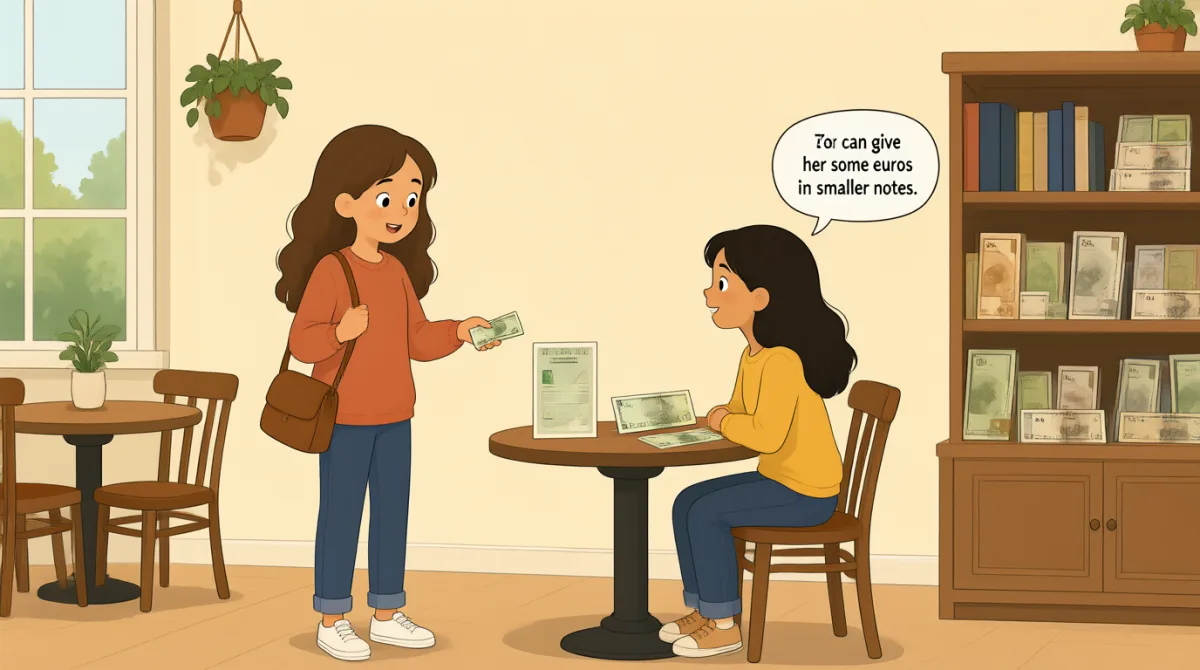

Can I have some small bills, please?
可以给我一些小面额的钞票吗?

Sure. I can give you smaller euro bills.
当然可以。我可以给你一些小面额的欧元纸币。
That would be great. Do you have tens?
太好了。你有十欧元的纸币吗?
Yes, I have tens and fives.
有,我有十欧元和五欧元的纸币。
Please give me two tens and four fives.
请给我两张十欧元和四张五欧元的纸币。
Of course. Here are two tens and four fives.
好的。这是两张十欧元和四张五欧元的纸币。
Thank you. These are easy to use.
谢谢。这些用起来很方便。
词汇6
- small bills小面额钞票
Small bills are notes with low values. You can ask for them when you need money that is easier to use.
小面额钞票是面值较小的纸币。如果你需要更方便使用的钱,可以向别人要一些小面额钞票。
- smaller euro bills小面额欧元纸币
These are euro notes with lower values. You can use this phrase to ask for smaller notes.
这是面值较小的欧元纸币。你可以用这个说法来要一些小面额纸币。
- tens十欧元纸币
Here, “tens” means ten-euro bills. Use it to ask for or talk about bills worth ten euros.
这里的“tens”指十欧元纸币。你可以用它来询问或谈论面值为十欧元的纸币。
- fives五欧元纸币
Here, “fives” means five-euro bills. Use it to ask for or talk about bills worth five euros.
这里的“fives”指五欧元纸币。你可以用它来询问或谈论面值为五欧元的纸币。
- That would be great.那太好了。
This is a polite way to say that an offer sounds good. You can use it when someone offers to help.
这是一种礼貌的说法,表示你觉得对方的提议不错。有人主动提出帮忙时,你可以这样回答。
- Of course.当然可以。
This is a friendly way to agree to a request. You can use it when you are happy to help.
这是一种友好的应答,表示你愿意答应对方的请求。你很乐意帮忙时可以这样说。
重点句子8
- 1
Can I have some small bills, please?
可以给我一些小面额的钞票吗?
Use this polite question to ask for bills with smaller values. You can replace “small bills” with another thing you need.
用这个礼貌的问句来索要面值较小的纸币。你也可以把“small bills”换成其他你需要的东西。
- 2
I can give you smaller euro bills.
我可以给你一些小面额的欧元纸币。
Use this sentence to offer someone smaller euro notes. Replace “smaller euro bills” with something else you can give.
用这个句子提出给别人一些小面额欧元纸币。你可以把“smaller euro bills”换成其他你能提供的东西。
- 3
That would be great.
那太好了。
Use this phrase to accept an offer warmly. It is useful in shops, at counters, and in everyday conversations.
用这个说法热情地接受对方的提议。在商店、柜台或日常交谈中都很实用。
- 4
Do you have tens?
你有十欧元的纸币吗?
Use this question to ask if someone has ten-euro bills. You can replace “tens” with another kind of bill.
用这个问句询问对方有没有十欧元纸币。你可以把“tens”换成其他面额的纸币。
- 5
Yes, I have tens and fives.
有,我有十欧元和五欧元的纸币。
Use this sentence to say which bills you have. Replace “tens and fives” with the bills or items you can offer.
用这个句子说明你有哪些纸币。你可以把“tens and fives”换成你能提供的纸币或其他物品。
- 6
Please give me two tens and four fives.
请给我两张十欧元和四张五欧元的纸币。
Use this polite request to say exactly what bills you want. Change the numbers and bill types to match what you need.
用这个礼貌的请求准确说明你想要哪些纸币。根据自己的需要更改数量和面额。
- 7
Of course.
当然可以。
Use this short reply to agree to a request. It sounds friendly and helpful.
用这个简短的回答来答应对方的请求,听起来友好又热心。
- 8
These are easy to use.
这些用起来很方便。
Use this sentence to say that something is convenient to use. Replace “These” with the things you are talking about.
用这个句子表示某样东西用起来很方便。你可以把“These”换成你正在谈论的东西。