Asking for an Umbrella
Preguntar por un paraguas
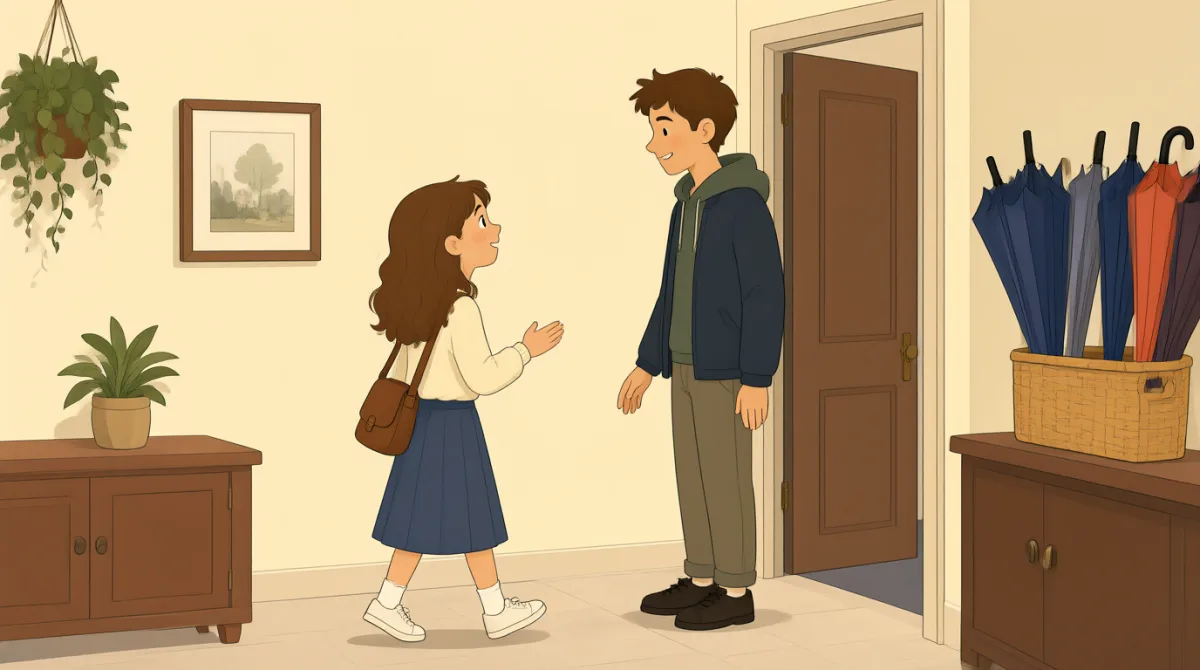
Emma and Leo go into a shop. Emma asks Jack if they sell umbrellas.
Emma y Leo entran en una tienda. Emma le pregunta a Jack si venden paraguas.
Diálogo6

Hi, do you sell umbrellas?
Hola, ¿venden paraguas?

Yes, we do. They are by the door.
Sí, vendemos. Están junto a la puerta.
Great. Can I look at them?
Genial. ¿Puedo verlos?
Sure. We have big ones and small ones.
Claro. Tenemos grandes y pequeños.
Thanks. It started to rain outside.
Gracias. Afuera empezó a llover.
I see. Take your time.
Ya veo. Tómate tu tiempo.
Vocabulario6
- sell umbrellasvender paraguas
This means to have umbrellas for sale in a shop. You can ask, “Do you sell [item]?”
Significa tener paraguas a la venta en una tienda. Puedes preguntar: “Do you sell [item]?” (¿Venden [artículo]?).
- by the doorjunto a la puerta
This means next to the door. Use “by” to say that something is near another place or thing.
Significa al lado de la puerta. Usa “by” para decir que algo está cerca de otro lugar o de otra cosa.
- Can I look at them?¿Puedo verlos?
This is a polite way to ask to see some things. You can use “Can I look at [item]?” in a shop.
Es una forma educada de pedir ver algunas cosas. En una tienda, puedes usar “Can I look at [item]?” (¿Puedo ver [artículo]?).
- big onesparaguas grandes
This means big umbrellas. “Ones” replaces a plural noun that you already mentioned.
Significa paraguas grandes. “Ones” reemplaza un sustantivo plural que ya has mencionado.
- small onesparaguas pequeños
This means small umbrellas. You can use “small ones” to talk about small items without repeating their name.
Significa paraguas pequeños. Puedes usar “small ones” para hablar de artículos pequeños sin repetir su nombre.
- take your timetómate tu tiempo
This means there is no need to hurry. It is a friendly phrase to use when someone is choosing something.
Significa que no hay necesidad de apresurarse. Es una expresión amable para usar cuando alguien está eligiendo algo.
Frases clave8
- 1
Hi, do you sell umbrellas?
Hola, ¿venden paraguas?
Use this simple question to ask if a shop has an item for sale. You can replace “umbrellas” with another item, such as “water.”
Usa esta pregunta sencilla para saber si una tienda tiene un artículo a la venta. Puedes reemplazar “umbrellas” por otro artículo, como “water”.
- 2
Yes, we do.
Sí, vendemos.
This is a short, natural way to answer “Do you…?” positively. You can use it to confirm that you sell or have something.
Es una forma breve y natural de responder afirmativamente a “Do you…?”. Puedes usarla para confirmar que vendes o tienes algo.
- 3
They are by the door.
Están junto a la puerta.
Use this sentence to tell someone where something is. Replace “by the door” with another place, such as “near the window.”
Usa esta oración para decirle a alguien dónde está algo. Reemplaza “by the door” por otro lugar, como “near the window”.
- 4
Great.
Genial.
This is a simple way to show that you are pleased or agree. You can use it as a short response in everyday conversations.
Es una forma sencilla de mostrar que algo te alegra o que estás de acuerdo. Puedes usarla como respuesta breve en conversaciones cotidianas.
- 5
Can I look at them?
¿Puedo verlos?
Use this polite question when you want to see items in a shop. Replace “them” with “it” if you are asking about one item.
Usa esta pregunta educada cuando quieras ver artículos en una tienda. Reemplaza “them” por “it” si preguntas por un solo artículo.
- 6
Sure.
Claro.
This is a friendly way to say yes. You can use it to agree to a request.
Es una forma amable de decir que sí. Puedes usarla para aceptar una petición.
- 7
Thanks.
Gracias.
Use this short phrase to show that you are grateful. It is useful after someone helps you.
Usa esta expresión breve para mostrar agradecimiento. Es útil después de que alguien te ayude.
- 8
It started to rain outside.
Afuera empezó a llover.
Use this sentence to say that rain began. You can replace “rain” with another thing that started, such as “the movie.”
Usa esta oración para decir que empezó a llover. Puedes reemplazar “rain” por otra cosa que haya empezado, como “the movie”.